

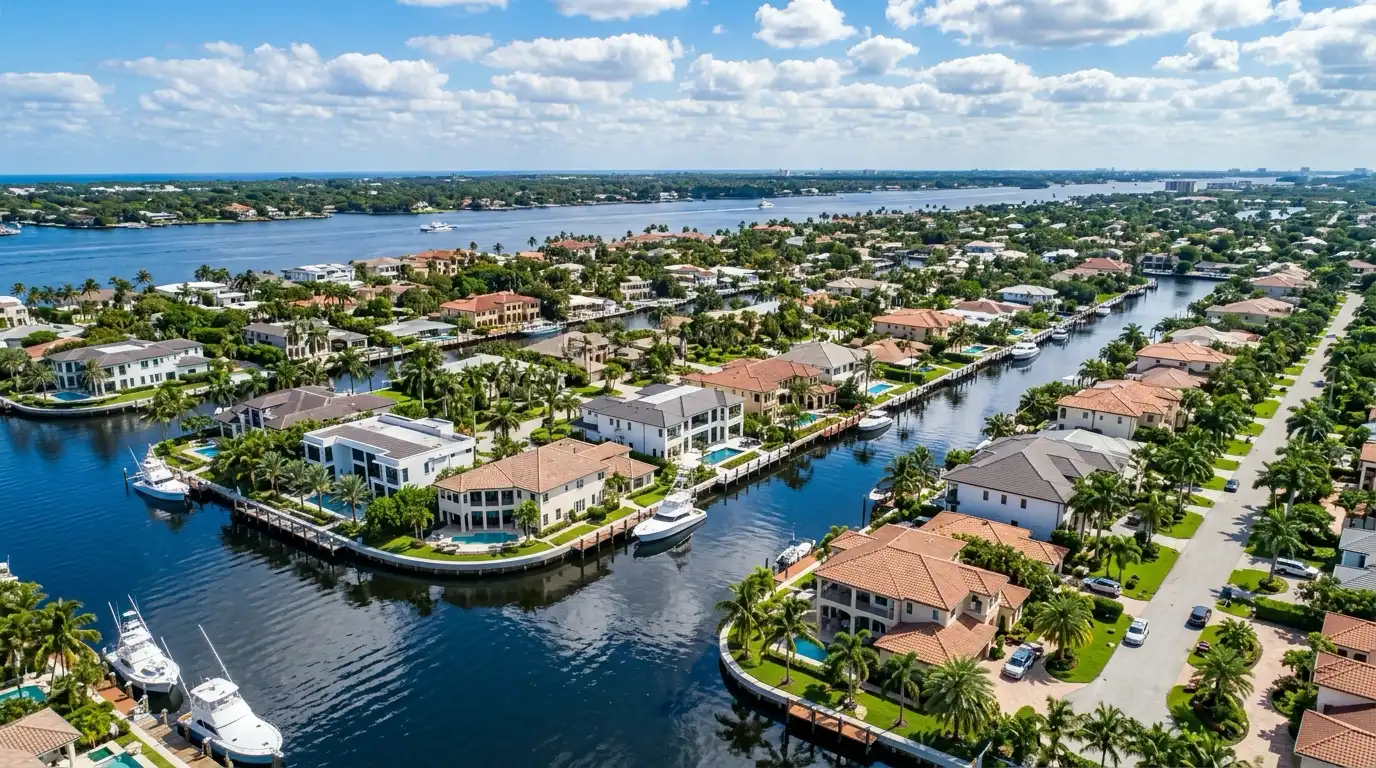
Parts of Boca Raton are in a FEMA high-risk flood zone and parts are not: the City of Boca Raton says a large portion of the city lies in FEMA’s Special Flood Hazard Area, where a federally regulated mortgage requires flood insurance, and our reading of FEMA’s current maps shows most of the mainland and west Boca mapped as moderate- or minimal-risk Zone X. On FEMA’s current maps, VE and AE zones run along the ocean and low ground on the barrier island, AE and AH zones are common near the Intracoastal and its canals, and inland AE, AH, and AO pockets sit around lakes and canals, so every lot has to be checked. Of the 13 FEMA map panels covering the city, 9 took effect on December 20, 2024 and 4 date from October 5, 2017, and FEMA’s Map Service Center showed no pending or preliminary panels for the city as of October 28, 2026. A National Flood Insurance Program homeowner policy covers at most $250,000 for the building and $100,000 for contents, and on FEMA’s Community Rating System list effective October 1, 2026, the city and unincorporated Palm Beach County both hold Class 5, worth 25 percent off NFIP premiums.
We are Steven, Elliot, and Wendy Koolik. Many of our buyers are relocating from New York and the Northeast, where flood was rarely part of the math. Here it comes up before almost every waterfront or east Boca offer we write. We never tell a client from memory that an address is in or out of a zone; we show you how to check, and we check with you.
The Quick Take
- Boca Raton’s flood zones change lot by lot. Check the address on FEMA’s Flood Map Service Center or the county lookup the city links to, or call the city at 561-393-7789 (inside city limits) or Palm Beach County at 561-233-5374 (unincorporated west Boca).
- The city’s current flood maps: 9 of 13 panels effective December 20, 2024, and 4 still at October 5, 2017. The 2024 revision raised base flood elevations by a foot or more on more than 16,000 Palm Beach County parcels.
- If the home is in an A or V zone and you finance it with a federally regulated lender, flood insurance is required for at least the lesser of the loan balance or the $250,000 NFIP building maximum. On a luxury home that minimum leaves most of the house uninsured for flood.
- Our analysis of FEMA’s published NFIP policy records puts the median total NFIP cost at about $910 a year in Zone X, $1,130 in Zone AH, and $1,650 in Zone AE for single-family homes in the city carrying the $250,000 building maximum (policies effective June 2025 to May 2026).
- Since October 1, 2024, Florida Statute 689.302 requires a seller to deliver a written flood disclosure at or before the contract is signed. Citizens Property Insurance requires flood coverage on most of its personal residential policies with wind coverage by January 1, 2027.
Checking a Specific Home’s Flood Zone?
Send us the addresses on your list. We will pull the flood zone and map panel, ask the city whether an elevation certificate is on file, and get a flood quote started before you write an offer.
Contact The Koolik GroupIs Boca Raton in a Flood Zone? The Answer by Type of Area
Technically, every Boca Raton property is in a flood zone, because Zone X is a flood zone too. What buyers usually mean is whether a home sits in a Special Flood Hazard Area, the land FEMA maps as having a 1 percent or greater chance of flooding in any year. Those zones begin with A or V, and they trigger a lender’s flood insurance requirement.
In our reading of FEMA’s National Flood Hazard Layer, the pattern runs roughly like this, with many exceptions; treat it as a starting expectation, never an answer for a lot.
| Type of area | Zones you commonly see on FEMA’s map | What it usually means for a financed purchase |
|---|---|---|
| Oceanfront and the beach side of the barrier island | VE along the shoreline, AE across lower ground behind it, X on some higher ground | Flood insurance required in VE and AE; VE adds FEMA’s storm-wave hazard |
| Intracoastal and canal-front neighborhoods on the mainland | AE and AH are common, with X on higher lots | Required in AE and AH; on a luxury home, price excess or private flood coverage too |
| East and central mainland away from the water | Mostly X (shaded and unshaded), with AE and AH pockets around lakes, canals, and low ground | Usually not required in X; required if the building sits in one of the pockets |
| West Boca, including the unincorporated county areas west of the city | Mostly X, with AE, AH, and AO pockets near lakes and drainage canals | Usually not required; check every lot, including those inside country club communities |
Our count of FEMA’s NFIP policy records shows the other side. Of the single-family policies written or renewed in the city between June 2025 and May 2026, about six in ten were rated Zone X, so many owners outside the high-risk area insure anyway. In the unincorporated west Boca ZIP codes, almost nine in ten were rated Zone X.
Do Not Rely on a Listing Line
“Not in a flood zone” in listing remarks is a marketing sentence, not a determination. Your lender will order its own flood determination, and FEMA offers a Letter of Determination Review if you dispute it.
How to Check the Flood Zone for a Boca Raton Address
1. FEMA’s Flood Map Service Center
Search the address on FEMA’s Flood Map Service Center to see the effective map panel, the zone, and any base flood elevation. Note the panel’s suffix letter: in the Boca Raton map set, panels ending in G took effect December 20, 2024, and panels ending in F date from October 5, 2017. If a seller document shows the same panel number with an earlier suffix letter, it was prepared on an earlier map; if it shows a different panel number, ask why.
2. The Palm Beach County lookup the city links to
The city’s Know Your Flood Zone page links to Palm Beach County’s flood zone lookup, which also covers unincorporated areas, where many homes with a Boca Raton mailing address sit.
3. Ask the floodplain office directly
Inside the city, Development Services at 561-393-7789 will tell you whether a building is in a Special Flood Hazard Area, whether the area has drainage problems or repeated flood claims, and whether an elevation certificate is on file, according to the city’s flood brochure. For unincorporated west Boca, call Palm Beach County’s Flood Zone Request Line at 561-233-5374.
Our Tip: Ask for the Elevation Certificate on Day One
The city keeps copies of elevation certificates for new or substantially improved buildings in the Special Flood Hazard Area. One call can tell you whether the home you are touring has one, and a quote that uses it can be built without waiting on a surveyor.
Which Flood Maps Are in Effect for Boca Raton?
FEMA adopted new Flood Insurance Rate Maps for Boca Raton and Palm Beach County on December 20, 2024. Palm Beach County says the revision added thousands of eastern county residents to high-risk zones and raised the base flood elevation by one foot or more on more than 16,000 parcels.
The revision did not replace every panel, as FEMA’s Map Service Center shows.
| Map item | Status as of October 28, 2026 | Why a buyer cares |
|---|---|---|
| City of Boca Raton panels | 13 panels: 9 effective December 20, 2024; 4 effective October 5, 2017 | Confirm which panel covers the home and which date it carries |
| Palm Beach County panels | 168 panels: 48 from December 20, 2024; 120 from October 5, 2017 | West Boca homes are often on the older panels |
| Pending or preliminary maps | None listed for the city or unincorporated county | FEMA has not released proposed new maps for review |
| Letters of Map Revision | Still being issued; the latest in unincorporated Palm Beach County took effect September 25, 2026 | Small areas change between map updates; check the address |
| Map amendment revalidation | FEMA lists a revalidation letter for the city dated December 21, 2024 | If a seller relies on a LOMA issued before the new maps, confirm it still applies on the current panel |
What Do the Flood Zone Letters Mean? AE vs. X and the Rest
The letters tell you how FEMA classifies the hazard and whether a federally regulated mortgage triggers mandatory flood insurance.
| Zone | FEMA’s description | Risk category | Insurance required with a federally regulated mortgage? |
|---|---|---|---|
| VE | Coastal areas with a 1 percent or greater annual chance of flooding and an additional hazard from storm waves | High risk, coastal | Yes |
| AE | The base floodplain, with base flood elevations shown on the map | High risk | Yes |
| AH | Shallow flooding, usually ponding, with average depths of 1 to 3 feet | High risk | Yes |
| AO | Shallow flooding, usually sheet flow, with average depths of 1 to 3 feet | High risk | Yes |
| A | High-risk floodplain without a base flood elevation on the map | High risk | Yes |
| X (shaded) | Moderate hazard, usually between the 100-year and 500-year flood limits | Moderate risk | No by federal rule; some lenders require it anyway |
| X (unshaded) | Minimal hazard, usually above the 500-year flood level | Low risk | No by federal rule; recommended by FEMA |
AE vs. X: the comparison buyers ask about most
An AE zone is inside the Special Flood Hazard Area, with a published base flood elevation, the height floodwater is expected to reach in a 1 percent annual chance flood. A financed purchase there requires flood insurance, and new construction or substantial improvement must meet elevation rules tied to that number. Zone X is outside the high-risk area, and insurance there is optional by federal rule, but FEMA reports that one in three flood claims come from low- and moderate-risk zones (the city and county cite about 40 percent). The difference is the lender requirement and the construction rules, not whether water can reach the house. Note AH too: shallow ponding, common in Boca Raton well inland, and high risk for lending.
Do I Need Flood Insurance in Boca Raton?
It depends on the zone, how you pay, and who insures the home against wind.
If you are financing and the building is in an A or V zone
Federal rules bar a national bank or federal savings association from making, increasing, extending, or renewing a loan on a building in a Special Flood Hazard Area unless the building carries flood insurance for the term of the loan. Florida’s Office of Insurance Regulation describes the requirement as applying to mortgages from federally regulated or insured lenders. The minimum is the lesser of the loan balance or the maximum coverage available, $250,000 for a home under the NFIP, and it covers the building, not the land. Lenders may require more, and some require flood insurance outside high-risk zones too.
On a $4 million loan against an Intracoastal home, that federal floor is $250,000 of building coverage. It satisfies the lender and leaves almost the entire house exposed.
If you are paying cash
No lender requirement applies to a cash purchase, but federal law can still attach one to the property: if the home received federal flood disaster assistance that was conditioned on carrying flood insurance, 42 U.S.C. 5154a requires the seller to notify the buyer in writing, by the transfer date, that flood insurance must be obtained and maintained. A yes to the FEMA assistance question on the Florida flood disclosure is your cue to ask. Otherwise flood insurance on a cash purchase is your decision, and the city encourages every owner, in a high-risk zone or not, to consider it. Cash buyers also do not get the loan-closing exception to the NFIP’s 30-day waiting period.
If Citizens writes your wind coverage
Citizens Property Insurance, Florida’s state-backed insurer, is phasing in a flood coverage requirement for personal residential policies that include wind, under a phase-in the Legislature created in December 2022. As of October 2026 it applies inside the Special Flood Hazard Area and to dwelling coverage of $400,000 or more, and by January 1, 2027 it reaches most such policies.
| Effective date | Citizens personal residential policies with wind coverage that must carry flood insurance |
|---|---|
| April 1, 2023 (new policies); July 1, 2023 (renewals) | Homes inside the Special Flood Hazard Area (A and V zones) |
| January 1, 2024 | Outside the Special Flood Hazard Area, dwelling coverage of $600,000 or more |
| January 1, 2025 | Dwelling coverage of $500,000 or more |
| January 1, 2026 | Dwelling coverage of $400,000 or more |
| January 1, 2027 | All policies, regardless of value |
Condominium unit-owner, tenant contents, and wind-excluded policies are exempt. Citizens asks for flood coverage at least equal to the dwelling coverage, accepting the NFIP maximum of $250,000 where that is all the NFIP offers.
Want the Flood Numbers Before You Offer?
We will line up the zone, the elevation certificate, and NFIP and private flood quotes on the exact home, so the cost is part of your price decision.
Contact The Koolik GroupHow Much Does Flood Insurance Cost in Boca Raton?
Since FEMA’s Risk Rating 2.0 took full effect on April 1, 2023, the NFIP prices each building on its own risk rather than mainly by zone, using flood frequency, flood types including storm surge and heavy rainfall, distance to water, elevation, and the cost to rebuild. NFIP rates are the same from every agent, and existing law keeps most annual increases at or below 18 percent.
The most useful local number is what owners actually paid. We pulled FEMA’s published NFIP policy records (OpenFEMA) for single-family homes carrying the $250,000 building maximum, with policies effective June 1, 2025 through May 31, 2026, and computed the medians ourselves: 5,509 policies in the City of Boca Raton and 5,686 in unincorporated Palm Beach County in ZIP codes 33428, 33433, 33434, 33496, and 33498. The cost is FEMA’s total policy cost: premium plus the federal policy fee, reserve fund assessment, and statutory surcharge. Most of these policies also carried contents coverage, usually $100,000, and its premium is included.
| Rated flood zone | City of Boca Raton: median annual NFIP cost (our calculation) | City: middle half of policies | Unincorporated west Boca ZIPs: median |
|---|---|---|---|
| X | About $910 | $741 to $1,086 | About $660 |
| AH | About $1,130 | $1,018 to $1,274 | About $950 |
| AE | About $1,650 | $1,214 to $2,248 (1 in 10 paid more than $2,961) | About $680 |
| AO | None in the city data | Not reported | About $630 |
| VE | Too few single-family policies to report | Not reported | None reported |
Four cautions. It is the NFIP layer only; excess or private coverage on a luxury home is a separate premium. It includes long-held policies still climbing toward their full-risk rate, while a new policy starts at full risk, so a new buyer on a waterfront lot can pay more. Homes that are not the owner’s primary residence, including second homes and rentals, paid more: the city’s median AE policy on a non-primary residence cost about $1,960, against about $1,590 on a primary one, partly because the statutory surcharge in FEMA’s data is $250 on a non-primary home and $25 on a primary one. And in west Boca, AE policies cost about the same as X policies, a reminder that under Risk Rating 2.0 the zone is no longer the only factor in the price. About four in ten of the city policies took effect before October 2025, when the city says its larger discount began.
Boca Raton’s Community Rating System discount
Communities that exceed the NFIP’s floodplain management minimum earn a Community Rating System class, each step worth 5 percent off NFIP premiums. The city says its improved class raised the discount on qualifying NFIP policies in all flood zones from 15 to 25 percent starting in October 2025, while FEMA’s list shows the Class 5 rating with a current effective date of April 1, 2025; ask your agent which date your renewal reflects. It applies to NFIP policies only; look for it on your invoice.
| Community | CRS class (FEMA list effective October 1, 2026) | NFIP premium discount |
|---|---|---|
| City of Boca Raton | Class 5 | 25 percent |
| Unincorporated Palm Beach County (much of west Boca) | Class 5 | 25 percent |
| City of Delray Beach | Class 6 | 20 percent |
| Town of Highland Beach | Class 10 (not participating) | None |
Buyers comparing oceanfront condos just north of the city line should note the Highland Beach row.
Why the Federal Policy Is Not Enough on a Luxury Home
FEMA’s homeowner policy covers up to $250,000 for the building and $100,000 for contents, with separate deductibles. By our count of FEMA’s policy records for June 2025 to May 2026, about 96 percent of single-family NFIP policies in the city carried the building maximum.
The NFIP also excludes property outside the building, such as landscaping, decks, patios, fences, and pools, and temporary living expenses during repairs. Valuables such as original artwork are capped at $2,500.
Florida law lets authorized insurers write private flood, including excess coverage above an NFIP policy. The Office of Insurance Regulation says private carriers write primary or excess flood, some only for high-value homes, as stand-alone policies or homeowners endorsements, and may offer higher limits or broader coverage. Florida’s “preferred” private flood category must include additional living expenses.
| Option | Building limit | How it is priced | Things to confirm |
|---|---|---|---|
| NFIP policy | Up to $250,000 building, $100,000 contents | FEMA’s Risk Rating 2.0; same rate from every agent; CRS discount applies | 30-day wait unless bought with a loan; exclusions above; can sometimes be assumed from the seller |
| Excess flood over the NFIP | Set by the carrier, above the NFIP layer | Carrier’s own rating | What underlying policy it requires, waiting period, contents and living expense terms |
| Private primary flood | Set by the carrier | Carrier’s own rating; no CRS discount | Whether your lender accepts it (federally regulated lenders must accept policies meeting the federal private flood definition), waiting period, cancellation terms |
Think Twice Before Dropping a Discounted NFIP Policy
A new NFIP policy starts at the full-risk rate, while an existing policy below it generally rises no more than about 18 percent a year. Replacing such a policy with private coverage and later returning to the NFIP can mean starting over at full risk. Price both first.
Assuming the seller’s NFIP policy
FEMA says a buyer may be able to assume the prior owner’s NFIP policy, which may be prepaid through its term, keeping any below-full-risk rate on its capped path. It matters most on homes newly mapped into a high-risk zone in December 2024: FEMA’s Newly Mapped discount required buying or renewing within 12 months, a window that closed in December 2025.
Waiting periods and your closing date
An NFIP policy normally takes effect 30 days after purchase, with no wait when bought with a new, increased, extended, or renewed mortgage. A cash buyer should apply at least 30 days before closing or assume the seller’s policy. Private carriers set their own rules. Citizens stops binding new coverage whenever a tropical storm or hurricane watch or warning covers any part of Florida, so during hurricane season, June 1 through November 30, bind early.
Elevation Certificates: What They Show and Where to Get One
An elevation certificate shows how high a building is compared with how high floodwater is expected to get, including the first floor height above the ground. FEMA says most homeowners do not need one to buy flood insurance, except in A and V zones, where one may be needed. Under Risk Rating 2.0 it does not set the rate, but it can identify discounts.
Where to look:
- The seller: any elevation certificate, survey, or LOMA they hold.
- The City of Boca Raton, which keeps copies for new or substantially improved buildings in the Special Flood Hazard Area: 561-393-7789.
- Palm Beach County, for unincorporated west Boca: 561-233-5374.
- Otherwise, hire a land surveyor, engineer, or architect early in your inspection period.
FEMA also offers mitigation discounts for elevating all covered machinery and equipment and for proper flood openings.
LOMA and LOMR-F: getting a building removed from the high-risk zone
If a building sits above the base flood elevation but the map shows it inside the high-risk area, the owner can ask FEMA for a Letter of Map Amendment (LOMA), or a Letter of Map Revision Based on Fill (LOMR-F) if the ground was raised with fill.
| Item | LOMA | LOMR-F |
|---|---|---|
| What it establishes | The building or lot is on natural ground that would not be flooded by the base flood | The building or lot was elevated by earthen fill and would not be flooded by the base flood |
| FEMA fee | None | FEMA charges a review fee |
| Data needed | Elevation information certified by a licensed land surveyor or registered professional engineer | |
| Timing | FEMA says it issues the determination within 60 days of receiving all required data | |
| Effect on the lender | The federal requirement can be removed, but the lender keeps the right to require flood insurance anyway | |
Planning a major renovation? Know the 50 percent rule
Under NFIP rules, a high-risk building that is substantially improved, meaning work costing 50 percent or more of the building’s market value, must meet current floodplain standards, including elevation. Palm Beach County warns that the higher 2024 base flood elevations may leave some existing homes below the elevation now required for a substantial improvement. Settle that with the floodplain office before pricing an older east Boca home. If a flood causes damage of 50 percent or more, FEMA’s Increased Cost of Compliance coverage can pay up to $30,000 toward bringing a high-risk building into compliance.
Florida’s Flood Disclosure Law: What Sellers Must Tell Buyers
Florida Statute 689.302, created by House Bill 1049 effective October 1, 2024 and amended effective October 1, 2025, requires a seller of residential real property to deliver a flood disclosure at or before the sales contract is executed. The statutory form opens with a notice that homeowners policies do not cover flood and encourages the buyer to discuss flood coverage with an agent. The seller then answers three questions:
- Whether the seller has knowledge of any flooding that damaged the property during the seller’s ownership.
- Whether the seller has filed a claim with an insurance provider for flood damage to the property, including a claim with the National Flood Insurance Program.
- Whether the seller has received assistance for flood damage to the property, including assistance from FEMA.
The statute defines “flooding” as a general or temporary condition of partial or complete inundation of the property caused by the overflow of inland or tidal waters, the unusual and rapid accumulation of runoff or surface waters from any established water source such as a river, stream, or drainage ditch, or sustained periods of standing water resulting from rainfall. The 2025 amendment also brought flood disclosure to residential leases of one year or longer.
The form asks only about the seller’s own knowledge, claims, and assistance, and it sits on top of Florida’s Johnson v. Davis rule: a seller who knows of facts that materially affect value, are not readily observable, and are not known to the buyer must disclose them, so a known, hidden problem that affects value, such as recurring drainage trouble, is a disclosure question for your attorney even if the three boxes are checked “no.”
Sea Level and Tidal Flooding: What the Public Sources Say
FEMA says its maps reflect historical data and other factors, and it updates them periodically. For a longer view, the City of Boca Raton publishes the Southeast Florida Regional Climate Change Compact’s 2019 unified projection, which the Compact reaffirmed for planning use in 2024: 10 to 17 inches of sea level rise by 2040 and 21 to 54 inches by 2070, above the 2000 mean sea level at Key West, with wide uncertainty beyond 2070. The city points owners to the county’s vulnerability map and NOAA’s viewer.
Buyer Checklist
- Look up the flood zone and FIRM panel on FEMA’s Flood Map Service Center or the county lookup, and note whether the panel is from 2024 or 2017.
- Call the city (561-393-7789) or the county (561-233-5374) about an elevation certificate on file, drainage problems, and repeated claims.
- Request the seller’s flood declarations page, elevation certificate, any LOMA, and the signed flood disclosure.
- Quote three ways: assuming the seller’s NFIP policy, a new NFIP policy, and private primary or excess coverage sized to the rebuild cost.
- Confirm the amount and policy type your lender requires, including whether it accepts your private policy.
- If you are paying cash, apply for NFIP coverage at least 30 days before closing or arrange the policy assumption.
- If a closing falls between June 1 and November 30, bind wind and flood early to avoid a storm-related binding suspension.
Seller Checklist: What to Gather Before You List
- The current flood zone and FIRM panel.
- An elevation certificate: ask the city whether one is on file, or commission one before listing a waterfront home.
- Your flood declarations pages, NFIP and private, so a buyer can price an assumption.
- Any LOMA or LOMR-F, and confirmation that it still applies on the current panel if it was issued before December 20, 2024.
- A record of any flood damage, claims, and FEMA assistance during your ownership, for the statutory disclosure.
- Records of mitigation, such as elevated equipment, flood openings, drainage work, and seawall repairs, with permits.
Our East Boca seller’s guide covers the rest of the waterfront pre-listing work.
Condominium Buyers: Two Policies, Two Questions
In a condominium, any flood coverage on the building is the association’s policy, such as the NFIP’s Residential Condominium Building Association Policy, and the owner insures contents and interior items. FEMA applies a coinsurance penalty when an association policy covers less than 80 percent of replacement cost or the NFIP maximum, whichever is less, so ask for the declarations page.
Frequently Asked Questions
Is Boca Raton in a flood zone?
Parts of Boca Raton are in a FEMA high-risk flood zone and parts are not. The City of Boca Raton says a large portion of the city lies in FEMA’s Special Flood Hazard Area. In our reading of FEMA’s current maps, VE and AE zones run along the ocean and low ground on the barrier island, AE and AH zones are common near the Intracoastal and canals, and most of the mainland and west Boca is Zone X with high-risk pockets around lakes and canals. Every property sits in some zone, so the only reliable answer for a home comes from checking its address on the current FEMA map.
How do I find the flood zone map for a Boca Raton address?
Search the address on FEMA’s Flood Map Service Center, which shows the effective map panel, the zone, and any base flood elevation, or use the Palm Beach County flood zone lookup linked from the City of Boca Raton’s Know Your Flood Zone page. For homes inside the city, the Development Services office at 561-393-7789 will confirm the zone and whether an elevation certificate is on file. For unincorporated west Boca, call Palm Beach County’s Flood Zone Request Line at 561-233-5374. Note whether the panel dates from December 20, 2024 or October 5, 2017.
Do I need flood insurance in Boca Raton?
Flood insurance is required in Boca Raton if the building is in a FEMA high-risk zone (A or V) and the mortgage comes from a federally regulated or insured lender. The federal minimum is the lesser of the loan balance or the $250,000 NFIP building maximum, and lenders can require more. Cash buyers face no lender requirement, but federal law requires a seller to tell the buyer in writing if past federal flood disaster aid on the home was conditioned on keeping flood insurance. Citizens Property Insurance requires flood coverage on most of its personal residential policies with wind coverage by January 1, 2027. The City of Boca Raton encourages every owner to consider flood insurance.
What is the difference between an AE and an X flood zone?
An AE zone is inside FEMA’s Special Flood Hazard Area, land with a 1 percent or greater annual chance of flooding, and the map shows a base flood elevation for it. A financed purchase in AE requires flood insurance, and new construction or substantial improvement must meet elevation rules. Zone X is outside the high-risk area: shaded X is moderate risk, between the 100-year and 500-year flood limits, and unshaded X is minimal risk. Insurance is optional in X by federal rule, but FEMA reports one in three flood claims come from low- and moderate-risk zones.
How much does flood insurance cost in Boca Raton?
In our analysis of FEMA’s published NFIP policy records for the City of Boca Raton, single-family policies with the $250,000 building maximum and effective dates from June 2025 to May 2026 had a median total cost of about $910 a year in Zone X, $1,130 in Zone AH, and $1,650 in Zone AE, with one in ten AE policies above $2,961. In unincorporated west Boca ZIP codes, medians were about $660 in X and $680 in AE. New policies start at the full-risk rate, homes that are not a primary residence pay more, and excess coverage on a luxury home costs extra.
What discount does Boca Raton’s Community Rating System class give on flood insurance?
FEMA’s Community Rating System list effective October 1, 2026 shows the City of Boca Raton at Class 5, worth a 25 percent discount on National Flood Insurance Program premiums. The city says the discount rose from 15 percent to 25 percent for qualifying policies in all flood zones starting in October 2025, while FEMA’s list gives the class a current effective date of April 1, 2025. Unincorporated Palm Beach County, which includes much of west Boca, is also Class 5 at 25 percent. Delray Beach is Class 6 at 20 percent, and Highland Beach is Class 10 with no discount. The discount applies to NFIP policies, not private flood.
What is an elevation certificate, and does the City of Boca Raton have one on file for my home?
An elevation certificate shows how high a building sits compared with how high floodwater is expected to reach, including the home’s first floor height. Under FEMA’s Risk Rating 2.0 it does not set the premium, but it can identify discounts and it is the evidence behind a Letter of Map Amendment. The City of Boca Raton keeps copies for new or substantially improved buildings in the Special Flood Hazard Area; call Development Services at 561-393-7789 to ask. If none exists, a licensed land surveyor, engineer, or architect can prepare one.
What does Florida’s flood disclosure law require a Boca Raton seller to disclose?
Florida Statute 689.302, effective October 1, 2024 and amended effective October 1, 2025, requires a seller of residential property to deliver a written flood disclosure at or before the contract is signed. The seller states whether they know of flooding that damaged the property during their ownership, whether they filed a flood insurance claim, including with the National Flood Insurance Program, and whether they received flood assistance, including from FEMA. The form also notes that homeowners policies do not cover flood. Florida’s broader duty to disclose known facts that materially affect value and are not readily observable still applies.
Is NFIP flood insurance enough for a luxury home in Boca Raton?
Usually not. A National Flood Insurance Program homeowner policy covers at most $250,000 for the building and $100,000 for contents, and it excludes pools, decks, patios, fences, landscaping, and temporary living expenses, with valuables such as original artwork capped at $2,500. By our count of FEMA’s policy records for June 2025 to May 2026, about 96 percent of single-family NFIP policies in the City of Boca Raton carried the building maximum. Owners of luxury homes can add private excess flood above the NFIP layer or buy a private primary policy, both of which Florida law allows authorized insurers to write.
Can I take over the seller’s flood insurance policy when I buy a home in Boca Raton?
You may be able to. FEMA says a buyer may be able to assume the prior owner’s National Flood Insurance Program policy, which may be prepaid through its current term, and that a rate still below the full-risk level usually rises no more than about 18 percent a year. A new policy starts at the full-risk rate. Assumption can be worth real money on a Boca Raton home that was newly mapped into a high-risk zone on December 20, 2024, if the owner locked in FEMA’s Newly Mapped discount before the window closed in December 2025.
Buying or Selling Near the Water?
With 4,800+ homes sold across South Florida, we know which documents close a waterfront deal on time. Let us run the flood picture on your home first.
Contact The Koolik GroupWaterfront and East Boca
- Boca Raton Waterfront Homes: Intracoastal vs. Oceanfront vs. Canal
- East Boca Raton Seller’s Guide: Selling a Waterfront, Oceanfront, or Intracoastal Home
- The Sanctuary, Golden Harbour, and Boca Raton’s Intracoastal Communities: The Complete Waterfront Guide
Insurance and the Cost of Ownership
- Homeowners Insurance for Luxury Homes in Boca Raton (2026): Costs, Wind Coverage, and How to Lower the Premium
- The Cost to Own a $5 Million Home in Boca Raton
- Florida Condo Law in 2026: What Boca Raton Condo Owners and Buyers Need to Know
Buying, Selling, and Relocating
Flood zone, map, and policy figures are drawn from FEMA (the Flood Map Service Center, the National Flood Hazard Layer, FloodSmart, the Community Rating System list effective October 1, 2026, and OpenFEMA policy records for policies effective June 1, 2025 through May 31, 2026, from which The Koolik Group computed the medians and shares shown), the City of Boca Raton, Palm Beach County, Citizens Property Insurance, the Florida Office of Insurance Regulation, federal regulations, and the 2026 Florida Statutes, as of October 12, 2026, with FEMA map status, the Community Rating System list, Citizens’ flood requirement, and the flood disclosure statute rechecked October 28, 2026. Maps, premiums, insurer rules, and statutes change, and zone descriptions here are never a determination for a specific property. Confirm the flood zone with FEMA or the local floodplain office, the premium and coverage with a licensed insurance agent, lender requirements with your lender, and disclosure obligations with a Florida real estate attorney.
Social Cookies
Social Cookies are used to enable you to share pages and content you find interesting throughout the website through third-party social networking or other websites (including, potentially for advertising purposes related to social networking).