

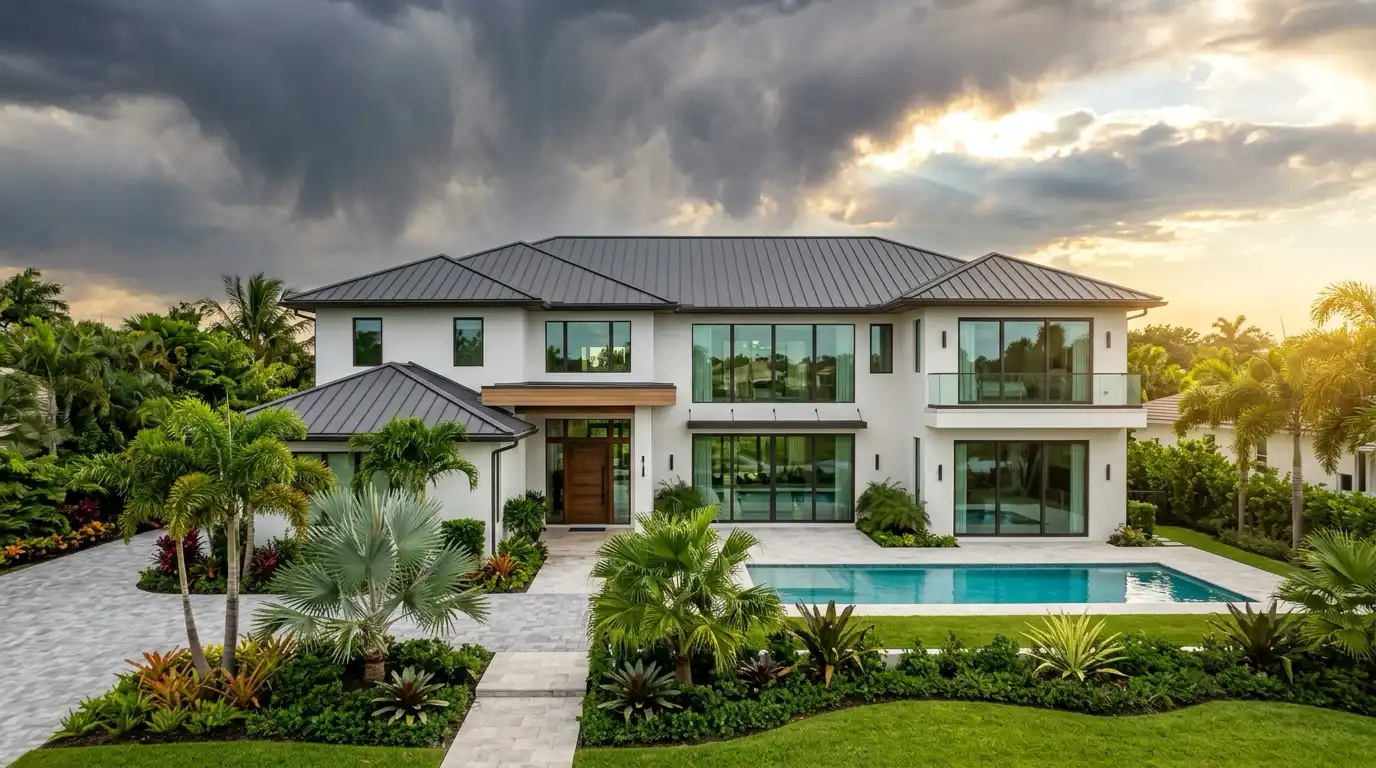
Most luxury homes in Boca Raton cannot be insured by Citizens Property Insurance, because Florida law bars Citizens from insuring a Palm Beach County home with a dwelling replacement cost of $700,000 or more, so they are insured in the private high-value market, either by admitted carriers, several of which specialize in high-value homes, or by surplus lines insurers. There is no single price: for scale, the Florida Surplus Lines Service Office reported that surplus lines HO-3 policies on Palm Beach County homes averaged about $15,900 in dwelling (Coverage A) premium at limits of $1 million to $5 million and about $47,700 at $5 million to $10 million in 2025 (January 2026 report), averages that exclude admitted carriers and do not predict any one home’s premium. On an admitted policy, the hurricane deductible is a percentage of the dwelling limit applied once per calendar year, so 5 percent on a $3 million dwelling means up to $150,000 for the year’s hurricane losses, plus the regular deductible on a later hurricane once that is used up. The market itself has turned: on May 20, 2026, the Office of Insurance Regulation counted 20 new insurers since the 2022 and 2023 reforms, still its latest count, and it approved another round of homeowners rate decreases on September 22, 2026.
We are Steven, Elliot, and Wendy Koolik. Over more than three decades of selling homes in Boca Raton and Delray Beach, we have watched insurance become the number that decides whether a deal closes on schedule. Buyers relocating from New York are usually surprised twice: by the hurricane deductible, and by learning that Citizens, and many private insurers, will not bind a new policy while a tropical storm or hurricane watch is up. This guide covers the high-value market, what drives a luxury premium, the inspections insurers want, and how to time quotes around closing.
The Quick Take
- Citizens cannot insure a home with a dwelling replacement cost of $700,000 or more in Palm Beach County (Florida Statute 627.351). The test is rebuild cost, not purchase price.
- At a dwelling limit of $3 million or more, Florida law requires admitted insurers, with limited exceptions, to offer 5 and 10 percent hurricane deductibles: $150,000 or $300,000 on a $3 million dwelling, $300,000 or $600,000 on a $6 million dwelling.
- Surplus lines policies are common at the top of the market. They are not covered by the Florida Insurance Guaranty Association, and no Florida regulator approves their rates or forms.
- An admitted insurer may not refuse to issue or renew a homeowners policy solely because a roof is under 15 years old, or older with an inspection showing five or more years of useful life (Florida Statute 627.7011).
- Citizens suspends new binding statewide whenever a tropical storm or hurricane watch or warning covers any part of Florida, most recently from October 7 to October 10, 2026 for Isaias.
- My Safe Florida Home grants require an insured value of $700,000 or less and, since a 2026 amendment, a low- or moderate-income applicant, so luxury homes almost never qualify.
Get the Insurance Number Before You Write the Offer
Send us your shortlist. We will help gather the wind mitigation report, roof permit, and four-point inspection the insurer will want, so your agent can quote the real house before your inspection period starts running.
Contact The Koolik GroupWhat Does Homeowners Insurance Cost on a Luxury Home in Boca Raton?
A luxury premium is priced one house at a time, and any average is a reference point, not a quote. The Florida Office of Insurance Regulation (OIR) reports an admitted-market average of $3,736 a year including wind, and $2,124 excluding wind, with data as of October 2026. That is a statewide average across admitted-market policies, excludes Citizens and surplus lines, and tells you little about a $4 million house on the water.
The closer reference is the Florida Surplus Lines Service Office’s January 2026 report, which breaks out surplus lines HO-3 premiums by dwelling limit and county. These are dwelling coverage premiums only, with no flood, liability, or contents.
| Dwelling limit (Coverage A) | Palm Beach County average, 2024 | Palm Beach County average, 2025 | Statewide surplus lines policies, 2025 |
|---|---|---|---|
| $500,000 to $1 million | About $7,700 | About $6,200 | 35,686 |
| $1 million to $5 million | About $18,400 | About $15,900 | 15,331 |
| $5 million to $10 million | About $58,300 | About $47,700 | 1,090 |
Source: Florida Surplus Lines Service Office, Coverage A Trends in the Surplus Lines Market, January 2026 (data as of January 28, 2026). Coverage A premium only. The office cautions that surplus lines data is not a proxy for the admitted market and should not be used for price comparison.
Read those numbers as direction. One tier holds both a 2015 west Boca house with impact glass and a 1978 Intracoastal house with original windows, and they will not be priced alike. Our guide to the cost to own a $5 million home in Boca Raton places insurance in a full annual budget.
What Changed After Florida’s 2022 and 2023 Insurance Reforms?
In 2022 the market was in visible trouble: OIR reports the average approved homeowners rate change in July 2022 was an increase of 15.33 percent, and Florida’s domestic property insurers ran a pooled combined ratio of 109 percent, paying more in losses and expenses than they earned in premium. The Legislature responded in stages.
| Law | When | What it changed |
|---|---|---|
| Senate Bill 2-D | May 2022 special session; roof rule applies to policies issued or renewed from July 1, 2022 | $2 billion state reinsurance fund; no refusals based solely on the age of a roof under 15 years; optional roof deductible with a required premium credit |
| Senate Bill 2-A | December 2022 special session | Ended one-way attorney fees; barred assignment of benefits on residential policies issued from January 1, 2023; $1 billion in temporary reinsurance; one year instead of two to report a claim; 60 days instead of 90 to pay or deny; flood requirement for Citizens customers |
| House Bill 837 | Signed March 24, 2023 | Broader litigation reform, including modified comparative negligence and the end of one-way attorney fees |
| House Bill 1549 | Signed June 13, 2025 | Ended the surplus lines “diligent effort” requirement; added a disclosure that surplus lines rates and forms are not state-approved |
The results, in the regulator’s numbers:
- New capacity. On May 20, 2026, OIR announced 20 new property insurers since the reforms, with more than $850 million in new capital. OIR describes some of the new entrants as focused on particular segments, such as new or newer home communities.
- Profitability. The pooled combined ratio for Florida domestic property companies was 83 percent at year-end 2025, down from 109 percent in 2022.
- Rate direction. On September 22, 2026, OIR announced approved rate decreases for four homeowners insurers covering more than 62,000 policies, with requested decreases of 3.2 to 10.4 percent, and reported that 48 companies have filed for decreases and 53 for no change since January 2024. It also cited S&P Global: Florida was the only state with a homeowners rate decrease in 2025, minus 0.92 percent, against a national increase of 5.5 percent.
- A smaller Citizens. Citizens reported 216,577 policies in force on October 23, 2026, against about 1.4 million in September 2023, and its homeowners multiperil rates fell an average 8.8 percent (5.1 percent wind-only) for policies effective from July 1, 2026.
For a luxury buyer, that means more carriers quoting, not cheap coastal insurance; one heavy-loss season can change carrier appetite quickly.
Why Are Most Luxury Homes Outside Citizens?
Citizens Property Insurance is the state-created insurer of last resort. Under Florida Statute 627.351, a home with a dwelling replacement cost of $700,000 or more, or a condominium unit with a combined dwelling and contents replacement cost of $700,000 or more, is not eligible. The limit is $1 million only in counties where OIR finds too little competition, which News Service of Florida reported in February 2024 were Miami-Dade and Monroe. Palm Beach County is under the $700,000 rule.
Because the test is rebuild cost, a modest older house on an expensive lot east of Federal Highway can sell for well over $2 million and still rebuild for under $700,000, leaving Citizens as a fallback. And an oceanfront condo owner’s HO-6 policy covers only the interior and contents, so many condo owners stay Citizens-eligible at prices where single-family buyers are not.
If a home does qualify, Citizens requires flood insurance on its personal residential wind policies: in a FEMA special flood hazard area since 2023, and elsewhere phased in by replacement cost, $600,000 and up from January 1, 2024, $500,000 from 2025, $400,000 from 2026, and all others from January 1, 2027, with condo unit owner policies excluded. And a home is generally ineligible for Citizens if an admitted insurer offers comparable coverage for no more than 20 percent above the Citizens premium (for a non-primary home, an approved surplus lines offer also counts).
Admitted High-Value Carriers and Surplus Lines
Above the Citizens line, a luxury home goes to one of two private markets. Admitted carriers are licensed in Florida, file rates and forms with OIR, and are backed by the Florida Insurance Guaranty Association (FIGA); several specialize in high-value homes. Surplus lines insurers are eligible but not licensed here and write many risks admitted carriers decline: more than 16,000 HO-3 policies statewide at dwelling limits of $1 million to $10 million in 2025.
| Feature | Admitted carrier | Surplus lines insurer | Citizens |
|---|---|---|---|
| Who can use it | Any home the carrier accepts | Any home the insurer accepts | Homes under $700,000 replacement cost in Palm Beach County |
| Rates and forms | Filed with OIR | Not approved by any Florida regulator | Approved by OIR |
| If the insurer fails | FIGA pays covered claims under $300,000, plus up to $200,000 more for homeowners structure and contents | No FIGA protection | No FIGA protection; deficits are covered by assessments, starting with up to 15 percent of premium on Citizens policyholders |
| Statutory hurricane deductible menu and roof-age rule | Apply | Chapter 627 does not apply unless it says so (our reading of Florida Statute 626.913) | Set by Citizens’ own approved rules; confirm with your agent |
| Paperwork | Standard application | Signed or acknowledged surplus lines disclosure | Flood policy required in a special flood hazard area or at $400,000 or more of replacement cost; all wind policies from 2027 |
Surplus Lines Is Not Worse, but It Is Different
For many waterfront and older luxury homes, a surplus lines policy is often the only offer, or the most competitive one. But it is a contract the state did not review. Read the windstorm or named storm deductible definition, any roof payment schedule, the exclusions, and the cancellation terms with your agent, and ask for the insurer’s financial strength rating, since FIGA will not stand behind it.
How Do Hurricane Deductibles Work in Florida?
A hurricane deductible is a separate, larger deductible for hurricane damage only. On an admitted policy, Florida Statute 627.701 sets four rules that matter on a luxury home.
- It is a percentage of the dwelling limit. Insurers must offer $500, 2, 5, and 10 percent options, with narrow exceptions. At $250,000 and up, $500 need not be offered; from $1 million to just under $3 million, 3 percent may replace 2 percent; at $3 million and up, 2 percent need not be offered, so the required offers are 5 and 10 percent.
- It applies once per calendar year to all hurricane losses with the same insurer or group. For a second hurricane, the insurer applies the larger of the remaining hurricane deductible or your regular deductible, and it may ask you to report smaller losses or keep receipts.
- It applies only to a hurricane: a storm the National Hurricane Center declares a hurricane, with the period starting when a hurricane warning is issued for any part of Florida and ending 72 hours after the last hurricane watch or hurricane warning for any part of Florida ends. In our reading, wind damage from a storm that never becomes a hurricane falls under the regular deductible on an admitted policy.
- The dollar amount must appear on your declarations page at issuance and, at renewal, on the renewal declarations page or premium renewal notice. Check that figure, not just the percentage.
A Worked Example on a $3 Million and a $6 Million Dwelling
Coverage A is the rebuild cost, not the price; a $6 million sale may carry a $3.5 million dwelling limit.
| Dwelling limit (Coverage A) | 2 percent (not required at this limit) | 5 percent (required offer) | 10 percent (required offer) |
|---|---|---|---|
| $3,000,000 | $60,000 | $150,000 | $300,000 |
| $6,000,000 | $120,000 | $300,000 | $600,000 |
The calendar-year rule: the $3 million dwelling carries a 5 percent deductible of $150,000. An August hurricane causes $90,000 of damage; you pay it and document it with the insurer. An October hurricane causes $400,000. Only $60,000 of the hurricane deductible remains, so, assuming your regular deductible is smaller, the insurer pays $340,000 rather than $250,000.
If your mortgage will be sold to Fannie Mae, its Selling Guide caps each deductible, including a windstorm deductible, at 5 percent of coverage; loans Fannie Mae does not buy follow the lender’s own limits, so ask before choosing 10 percent. The statute states the Legislature’s intent to encourage higher hurricane deductibles, and the premium gap between 5 and 10 percent can be meaningful. A practical test is whether you could pay the deductible in October without selling anything.
Admitted carriers may also offer an optional roof deductible, capped at the lesser of 2 percent of Coverage A or half the roof replacement cost, with a required premium credit. It never applies to hurricane damage, and you may reject it by signing an OIR-approved form.
Choosing a Deductible on a Specific House?
We can show you what the dwelling limit, hurricane deductible, and lender rules mean in dollars on your shortlist.
Contact The Koolik GroupWhat Drives the Premium on a Luxury Home?
In our experience, six factors explain most of the difference between two homes at the same price.
Roof age and type
The roof is one of the first questions on an application. On an admitted policy, Florida law protects roofs under 15 years from refusal based on age alone. Age runs from the last time the whole roof surface was replaced, or the first of a series of partial replacements that together covered it, so one partial reroof does not reset the clock. The roof’s permit date and product approval also feed the wind mitigation form.
Wind mitigation features
Florida Statute 627.0629 requires residential rate filings to include actuarially reasonable discounts for features proven to reduce wind losses, and since October 1, 2023 insurers must describe those discounts on their websites. The features are recorded on the state’s Uniform Mitigation Verification Inspection Form, OIR-B1-1802. The current version, Rev. 04/26, has nine questions and has been mandatory for inspections since April 1, 2026.
| Form question (Rev. 04/26) | What the inspector records | Strongest answer on the form |
|---|---|---|
| 1. Building code | The Florida Building Code in force at the original permit application | FBC 2001 and 2004 (2002 or 2003 homes need a permit applied for after March 1, 2002) or FBC 2007 and later |
| 2. Region and 3. Roof slope | Design wind speed region; whether the main roof slope is at least 6:12 | Facts about the site and roof, not features you add |
| 4. Roof covering | Each covering, with permit date or product approval | All coverings documented as meeting the Florida Building Code |
| 5. Roof deck attachment | The weakest sheathing attachment, seen in the attic | 8d nails no more than 6 inches apart in the field, or equivalent, or a reinforced concrete deck |
| 6. Roof-to-wall attachment | The weakest roof-to-wall connection | Double wraps or structural anchoring |
| 7. Roof geometry | Roof shape | A hip roof, with no other shapes over 10 percent of the perimeter |
| 8. Sealed roof deck | A barrier under the covering (standard felt alone does not count) | Fully adhered underlayment, taped seams, a double layer of qualifying felt or synthetic, or qualifying spray foam |
| 9. Opening protection | The weakest protection on every window, door, and skylight | Impact protection tested to the 9-pound large missile on every glazed opening, with rated doors |
Two details catch buyers. Every opening counts, doors and skylights included, because the weakest one controls, and on the current form a damaged opening disqualifies the home from wind mitigation credits. Without attic access, deck and roof-to-wall attachment and a sealed deck may go unverified. FORTIFIED Home certificates can validate several answers.
Construction year and code
Homes permitted under the Florida Building Code start ahead (the current form also separates the 2007 code and later); Citizens, for example, gives a code compliance discount to homes built on or after January 1, 2002. Palm Beach County is outside the High-Velocity Hurricane Zone, which the form limits to Miami-Dade and Broward. A 1980s Mediterranean can still insure well, usually because its roof and openings have been modernized.
Distance to the coast
Oceanfront and Intracoastal addresses carry the most wind exposure, and agents tell us admitted carriers decline them most often. Our waterfront comparison covers the other costs of the water.
Replacement cost of custom finishes
The dwelling limit should reflect the cost to rebuild with the same stone, millwork, glass, and systems at current prices. Underinsuring saves premium until the claim; overinsuring raises both the premium and the percentage deductible. Insurers must offer replacement cost coverage, may offer guaranteed replacement cost, and must offer law and ordinance coverage at 25 or 50 percent of the dwelling limit to pay for rebuilding to current code, which matters most on older homes. A policy includes the 25 percent level unless you reject it in writing.
Claims history
Prior water, roof, and wind claims on the property and on the buyer’s record affect eligibility and price. Ask the seller early for the claims history and repair permits.
Which Inspections Will the Insurer Ask For When You Buy?
Three documents serve the insurer, and the smoothest closings have all three before the offer.
The four-point inspection
A four-point inspection is a limited insurance report on the roof, electrical, plumbing, and HVAC systems: type, age, condition, and visible hazards. It is not a full home inspection, and no statute requires one; each carrier decides at what home age it wants one. A South Florida inspector’s 2026 pricing puts a four-point at about $100 to $175, and about $180 to $220 combined with wind mitigation, with more for large homes with several electrical panels or air-conditioning systems.
The wind mitigation inspection
This inspection completes form OIR-B1-1802, at about $100 to $175 on the same 2026 pricing. Citizens, for example, accepts the prior Rev. 01/12 form if completed within five years before April 1, 2026 with no changes to the house; newer inspections must use Rev. 04/26. Hand the inspector your roofing permit, product approvals, notice-of-acceptance letters, and invoices, because undocumented features often go uncredited.
Roof certification and Florida’s roof-age law
Under Florida Statute 627.7011(5), for policies issued or renewed from July 1, 2022, a homeowner with a roof 15 years or older may pay for an inspection by an authorized inspector approved by the insurer (a licensed home inspector, building code inspector, contractor or roofer, engineer, or architect). If it shows five or more years of useful life, the insurer may not refuse to issue or renew based on roof age alone.
Insuring a Home With an Older Roof
- Order the roof inspection before you list, or before your inspection period ends if you are buying.
- The law stops refusals based on age alone, not refusals for poor condition or other lawful reasons.
- In our reading, the rule does not bind a surplus lines policy, so confirm with your agent if that is the best quote.
- For roofs built to the 2007 Florida Building Code or later, Florida Statute 553.844 requires only the repaired portion of a repair covering 25 percent or more of the roof to meet current code.
- If the roof must be replaced, price it into the offer and add a sealed deck and stronger connections for wind credits.
Can You Buy Homeowners Insurance During a Hurricane Watch?
Usually not. Citizens’ rule: agents may not bind new or increased coverage, regardless of effective date, while a tropical storm or hurricane watch or warning is in effect for any part of Florida. Private carriers set their own rules and commonly suspend new business when a storm threatens. A financed buyer cannot close without a bound policy, so a suspension in closing week can delay the closing. Citizens’ notices show how often it happens.
| Storm | Citizens binding suspended | Lifted |
|---|---|---|
| Isaias | October 7, 2026, 11:05 a.m. | October 10, 2026, 5 a.m. |
| Tropical Depression Two / Bertha | July 19, 2026, 11 a.m. | July 22, 2026, 2 p.m. |
| Tropical Depression Nine / Imelda | September 27, 2025, 11:01 a.m. | September 28, 2025, 5:01 p.m. |
| Rafael | November 4, 2024, 4:15 p.m. | November 7, 2024, 7:15 a.m. |
| Milton | October 7, 2024, 5 a.m. | October 10, 2024, 5:01 p.m. |
| Potential Tropical Cyclone Nine / Helene | September 23, 2024, 5:05 p.m. | September 27, 2024, 8:27 a.m. |
| Potential Tropical Cyclone Four / Debby | August 2, 2024, 11:06 a.m. | August 6, 2024, 8:01 a.m. |
Source: Citizens Property Insurance binding alerts, 2024 to 2026. All statewide; times Eastern.
Hurricane season runs June 1 to November 30, peaking around September 10. There were four suspensions in 2024, lasting from about two and a half days (Rafael) to about four days (Debby). The fix: bind the policy well before closing, effective on the closing date, so there is no new binding request when a watch goes up.
If a storm does interfere, the standard Florida Realtors/Florida Bar “AS IS” contract extends closing under its force majeure standard when an event such as a hurricane makes hazard, wind, flood, or homeowners insurance unavailable: up to seven days after the event stops preventing performance, and either party may terminate if it runs more than 30 days past closing. Confirm your contract’s revision and its effect with your attorney. Sellers should plan for the storm months too; see The Best Time to Sell a Luxury Home in Boca Raton: How the Season Really Works (2026).
Does My Safe Florida Home Help With a Luxury Home?
Mostly no. The state program, run by the Department of Financial Services under Florida Statute 215.5586, has two parts:
- A free wind mitigation inspection for a site-built, owner-occupied single-family home on its own parcel with a Florida homestead exemption. There is no value cap on the inspection.
- A grant for homes with an insured value of $700,000 or less, built before January 1, 2008, for low- or moderate-income applicants (a 2026 condition), at $2 from the state for every $1 from the owner, up to $10,000.
A homesteaded luxury owner may get the free inspection, but almost no luxury home or owner qualifies for the grant, and seasonal owners without a homestead exemption qualify for neither. The program depends on annual funding; its site advertised open inspections and grants in October 2026. On a high-value home, treat mitigation as a capital improvement, and ask your agent to quote the premium with and without each feature before you spend.
Flood Insurance and Condominiums
Flood is always a separate policy
Florida law requires homeowners policies without flood coverage to warn on the declarations page that flood is not covered, even when hurricane wind and rain caused it. National Flood Insurance Program building coverage stops at $250,000 and contents at $100,000, so luxury owners near the water typically add excess flood above a primary policy. See our new guide, Is Boca Raton in a Flood Zone? Flood Zones, Elevation Certificates, and Flood Insurance for Buyers (2026).
Condos: your HO-6 versus the master policy
The association’s master policy covers the building, not your interior finishes, fixtures, appliances, or belongings; see the condo question in the FAQ below and our guide to Florida condo law in 2026.
Which Levers Actually Lower a Luxury Premium?
Most levers depend on the carrier’s filed rating plan, so we give a percentage only where the law sets one.
| Lever | What it changes | Basis |
|---|---|---|
| Current wind mitigation report (Rev. 04/26) | Discounts on the wind portion for each documented feature; amount varies by carrier | Florida Statute 627.0629; Citizens applies credits to the wind portion only |
| Higher hurricane deductible | Lower premium; 5 to 10 percent on a $3 million dwelling adds $150,000 of exposure | Florida Statute 627.701 |
| Deductible credit for mitigation | Insurer must offer a lower hurricane deductible or a discount for mitigation | Florida Statute 627.701(9) |
| Impact protection on every opening | Improves the opening protection answer; the weakest opening controls | Form OIR-B1-1802 (Rev. 04/26), question 9 |
| Reroof with sealed deck and wraps | Can improve four answers at once; a full reroof resets roof age | Form questions 4, 5, 6, and 8 (Rev. 04/26); Florida Statute 627.7011(5) |
| Monitored alarms and sprinklers | May qualify for discounts, by carrier | Citizens discount brochure |
| Binding arbitration option, where offered | Premium break in exchange for arbitrating disputes | Senate Bill 2-A, 2022; weigh the trade-off |
A Buyer’s Insurance Timeline
- Before the offer: ask for the seller’s wind mitigation report, four-point, roof permit, opening protection approvals, and any elevation certificate, and get an indicative quote from a licensed agent who writes high-value homes.
- Contract day: send the documents to your agent for firm quotes. If nothing is current, order the four-point and wind mitigation inspections with your home inspection.
- Before the inspection period ends: accept a quote, with the dwelling limit, hurricane deductible, and flood policy decided, and confirm your lender’s maximum deductible. If the offers are surplus lines, read the terms now.
- At least two weeks before closing, earlier in hurricane season: bind homeowners and flood with the closing date as the effective date, and send the binders to the lender and title agent.
Also send your agent your current policy, including liability and umbrella limits and scheduled valuables; our New York relocation guide covers the rest of the move.
A Seller’s Insurance Checklist
Put these in the listing package:
- A recent wind mitigation report on the Rev. 04/26 form.
- The roof permit showing the last full replacement; for a roof 15 years or older, an inspection documenting remaining life.
- A four-point inspection.
- Product approvals and invoices for impact windows, doors, and shutters.
- Prior inspections, claims history, and repair permits.
- An elevation certificate and flood policy details.
Waterfront sellers should also read our East Boca Raton seller’s guide for the seawall and dock inspections buyers order.
Frequently Asked Questions
How much is homeowners insurance on a luxury home in Boca Raton?
There is no single figure; each luxury home in Boca Raton is priced on its rebuild cost, roof, mitigation features, and location. For reference, the Florida Surplus Lines Service Office reported that surplus lines HO-3 policies in Palm Beach County averaged about $15,900 in dwelling-coverage premium at dwelling limits of $1 million to $5 million and about $47,700 at $5 million to $10 million in 2025. Those averages exclude admitted carriers, flood, liability, and contents, and they are not a quote for any individual home. The Florida Office of Insurance Regulation’s admitted-market average of $3,736 including wind (data as of October 2026) is a statewide average across admitted carriers, excluding Citizens and surplus lines.
What is the Citizens Property Insurance coverage limit?
Under Florida Statute 627.351, Citizens Property Insurance cannot insure a home with a dwelling replacement cost of $700,000 or more, or a condominium unit whose combined dwelling and contents replacement cost is $700,000 or more. The limit is $1 million only in counties where the Florida Office of Insurance Regulation finds too little competition, reported in 2024 as Miami-Dade and Monroe. Palm Beach County, including Boca Raton, is under the $700,000 rule. The test is rebuild cost, not purchase price, so an older home on a valuable lot can still qualify.
Where do luxury homeowners in Florida get insurance?
Luxury homes in Florida are insured in the private high-value market. Some admitted carriers specialize in high-value homes; they file rates and forms with the Florida Office of Insurance Regulation and are backed by the Florida Insurance Guaranty Association. Surplus lines insurers write many coastal and older luxury homes; no Florida regulator approves their rates or forms, the guaranty association does not cover them, and buyers sign or acknowledge a disclosure. A licensed agent can quote both markets.
How does a hurricane deductible work in Florida?
On an admitted Florida policy, the hurricane deductible is a percentage of the dwelling limit that applies once per calendar year to all hurricane losses with the same insurer or insurer group. Florida Statute 627.701 generally requires $500, 2, 5, and 10 percent options, but at a dwelling limit of $3 million or more the required offers are 5 and 10 percent: $150,000 or $300,000 on a $3 million dwelling, and $300,000 or $600,000 on a $6 million dwelling. The hurricane period starts when a hurricane warning is issued for any part of Florida and ends 72 hours after the last hurricane watch or hurricane warning ends.
How much can a wind mitigation inspection save on Florida insurance?
A Florida wind mitigation inspection documents features such as a hip roof, roof-to-wall wraps, a sealed roof deck, and impact-rated openings on form OIR-B1-1802 (Rev. 04/26, required since April 1, 2026). Florida Statute 627.0629 requires insurers’ rate filings to include actuarially reasonable discounts, credits, or deductible reductions for these features, and Citizens applies them to the wind portion of the premium. The size of the discount depends on each carrier’s filed rating plan and the home’s features, so no fixed percentage applies. A South Florida inspector’s 2026 pricing puts the inspection at about $100 to $175.
What is a four-point inspection in Florida?
A Florida four-point inspection is a limited report for insurers on four systems: the roof, electrical, plumbing, and heating and air conditioning. It records type, age, condition, and visible hazards, and it is not a full home inspection. No Florida statute requires one; each insurance carrier decides at what home age it asks for one. A South Florida inspector’s 2026 pricing puts a four-point at about $100 to $175, or about $180 to $220 combined with a wind mitigation inspection, with higher fees for large homes with several electrical panels or air-conditioning systems.
Can I get homeowners insurance on an older roof in Florida?
Often, yes. Florida Statute 627.7011, for policies issued or renewed from July 1, 2022, bars an insurer from refusing a homeowners policy solely because the roof is under 15 years old. For a roof 15 years or older, an authorized inspector approved by the insurer, such as a licensed roofer, home inspector, or engineer, can document remaining life at the homeowner’s expense; with five or more years left, the insurer may not refuse based on age alone. The rule does not prevent a refusal for poor condition, and in our reading it does not bind surplus lines policies, so confirm with a licensed agent.
Can you buy homeowners insurance during a hurricane watch in Florida?
Generally not. Citizens Property Insurance suspends binding of new or increased coverage, regardless of effective date, whenever a tropical storm or hurricane watch or warning is issued for any part of Florida; it did so from October 7 to October 10, 2026 for Isaias. Private carriers set their own rules and commonly stop new business when a storm threatens. Because a financed purchase cannot close without a bound policy, Florida buyers should bind homeowners and flood coverage well before closing, effective on the closing date, especially from June 1 to November 30.
Does My Safe Florida Home help owners of luxury homes?
Only partly. Under Florida Statute 215.5586, My Safe Florida Home offers a free wind mitigation inspection to owners of site-built, owner-occupied single-family homes with a Florida homestead exemption, with no value cap on the inspection. The grant, which pays $2 for every $1 the owner spends up to $10,000, requires an insured value of $700,000 or less, a home built before January 1, 2008, and, under a 2026 amendment, an applicant who qualifies as low- or moderate-income. Most luxury homes are insured far above $700,000, so they do not qualify for the grant, and seasonal owners without a homestead exemption qualify for neither part.
Does a Boca Raton condo owner need an HO-6 policy if the association has insurance?
In practice, yes. Under Florida Statute 718.111(11), a Florida condominium association’s master policy covers the building but excludes the unit’s floor, wall, and ceiling coverings, electrical fixtures, appliances, water heaters, built-in cabinets and countertops, window treatments, and personal property. The Boca Raton unit owner insures those items on an HO-6 policy, which must include at least $2,000 of loss assessment coverage. Owners with custom interiors should insure them at real replacement cost and check the master policy’s hurricane deductible.
Buy the House You Can Insure, and Close on Time
4,800+ homes sold across South Florida. We know which homes insure easily, which need a roof letter or new glass first, and how to keep a closing on schedule through hurricane season.
Contact The Koolik GroupCosts and Carrying Expenses
- The Cost to Own a $5 Million Home in Boca Raton [2026]
- Is Boca Raton in a Flood Zone? Flood Zones, Elevation Certificates, and Flood Insurance for Buyers (2026)
Buying and Selling in Boca Raton
- New Construction Luxury Homes in Boca Raton [2026]
- Florida Condo Law in 2026: What Boca Raton Condo Owners and Buyers Need to Know
- The Best Time to Sell a Luxury Home in Boca Raton: How the Season Really Works (2026)
- East Boca Raton Seller’s Guide: Selling a Waterfront, Oceanfront, or Intracoastal Home (2026)
Relocating and Waterfront
This guide is general information, not insurance or legal advice. Figures are drawn from the 2026 Florida Statutes, the Florida Office of Insurance Regulation, Citizens Property Insurance Corporation, the Florida Surplus Lines Service Office, the My Safe Florida Home program, the National Flood Insurance Program, Fannie Mae, and the other sources cited above, as of October 12, 2026, with Citizens’ binding alerts, eligibility rule, and policy count, the Office of Insurance Regulation figures, and My Safe Florida Home rechecked October 28, 2026. Premiums, rate filings, underwriting guidelines, program funding, and laws change, and averages do not predict the premium on any individual home. Confirm coverage, deductibles, and eligibility with a licensed Florida insurance agent and the insurer, and contract questions with a Florida real estate attorney.
Social Cookies
Social Cookies are used to enable you to share pages and content you find interesting throughout the website through third-party social networking or other websites (including, potentially for advertising purposes related to social networking).