

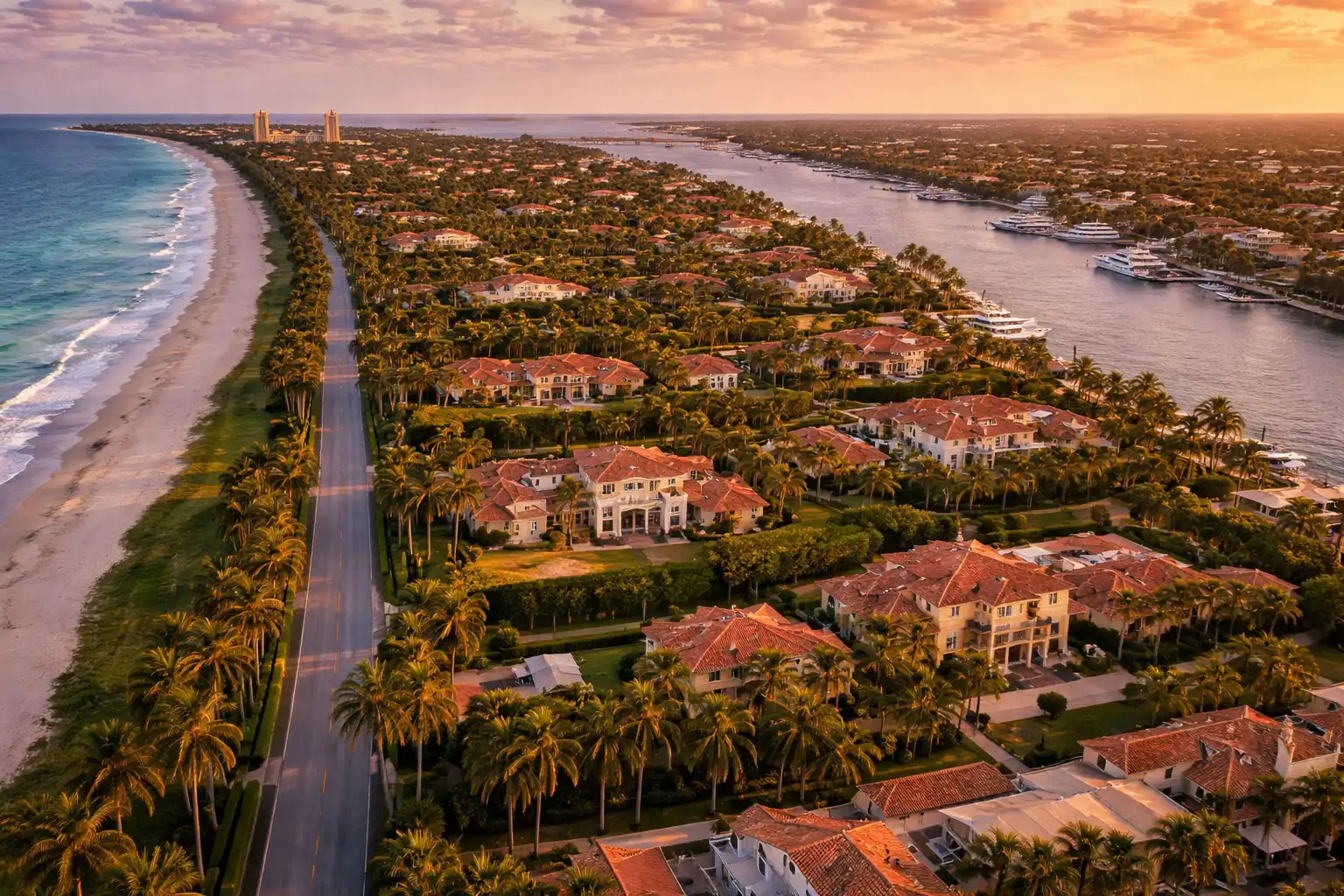
Palm Beach is not a neighborhood. It is not a suburb. It is an island — 18 miles long, no wider than three-quarters of a mile at its broadest point — and it operates by rules that apply nowhere else in American real estate. The Town of Palm Beach has produced the highest five-year home value appreciation of any major Florida market: 118.2% over the last five years, with an average home value now reaching approximately $9.8 million. In the first half of 2025, nearly 70% of all single-family transactions on the island closed above $10 million. The median single-family sale price reached $12.9 million by mid-2025. This is not hyperbole. This is a land-constrained, demand-driven market unlike anything else in South Florida.
We are Steven, Elliot, and Wendy Koolik. Our team has sold over 4,800 homes and closed more than $2.7 billion in sales across South Florida over 35 years. Our office is at 101 N Federal Highway in Boca Raton, and we work with buyers and sellers across the South Florida luxury corridor from Boca Raton north to Palm Beach Island. This guide covers the Palm Beach Island market in full: the neighborhoods, the historic estates, the private clubs, the co-op and condo buildings, the current market data, the buying process, and the lifestyle details that distinguish this market from every other luxury address in the state.
We wrote this the way we advise our clients — with verified data, honest assessments, and none of the superlatives that make luxury real estate content useless.
Palm Beach Island: Key Market Facts at a Glance
- Average home value: approximately $9.8 million (2025)
- Median single-family sale price (mid-2025): $12.9 million
- Five-year home value appreciation: 118.2% — highest of any major Florida city
- Ten-year appreciation: 156.4%
- Luxury sales $10M+ (H1 2025): nearly 70% of all single-family transactions
- All-cash transactions (Town of Palm Beach): 84% of sales
- Resident billionaires: 58, with combined net worth of $494.7 billion (2024)
- Island area: 4.2 square miles of land; population approximately 9,500
- State income tax: none
- Property tax millage (Palm Beach County, 2025): approximately 17.5 mills
Why Palm Beach Is the Pinnacle of Florida Luxury Real Estate
Palm Beach has occupied a singular position in American luxury real estate since Henry Morrison Flagler extended his Florida East Coast Railway to the island in the 1890s and opened The Breakers Hotel in 1896. What Flagler built — a destination for industrial-era wealth — was then architecturally defined by Addison Mizner starting in 1918, and has been preserved, amplified, and increasingly competed for by each successive generation of American wealth ever since.
The supply argument is simple and permanent: Palm Beach Island contains 4.2 square miles of land. It cannot expand. Every acre of it has been developed for over a century. The only way to acquire a position on the island is to buy one from someone who already owns it, and those sellers are rarely motivated by urgency. This structural scarcity is the foundation of every market dynamic that follows.
The demand argument has accelerated dramatically since 2019. Florida eliminated its state income tax burden decades ago, but the post-pandemic migration of financial industry capital to South Florida — anchored by Palm Beach County — has transformed the buyer pool. According to Fortune, as of 2024 the island is home to 58 billionaires including Ken Griffin, whose planned Palm Beach compound has been reported at a cost of $150 million to $400 million on approximately 20 oceanfront acres he assembled in 2023. Paul Singer of Elliott Management relocated his fund to West Palm Beach. Goldman Sachs expanded its Palm Beach County footprint in 2024. More than 200 investment firms have established a presence in South Florida in recent years, with a substantial concentration choosing Palm Beach County. The hedge fund and private equity migration that has been underway since 2019 has not reversed. It has deepened.
The result is a market where 84% of all transactions in the Town of Palm Beach close in cash, where the $20 million to $100 million segment now represents a meaningful and growing share of annual volume, and where vacant oceanfront land parcels routinely draw bids north of $50 million. In 2024 and 2025, the island recorded multiple transactions above $80 million, including an oceanfront mansion that changed hands for $86.5 million and a private island estate at $150 million. These are not outliers. They are the new normal for the upper tier of this market.
The Neighborhoods of Palm Beach Island
Palm Beach Island is divided informally into four geographic zones running north to south. Understanding the character and pricing of each zone is essential to evaluating any specific property.
The Estate Section
The Estate Section stretches from Worth Avenue south to Sloan’s Curve, and it contains the most historically significant and architecturally distinguished properties on the island. This is what most people picture when they think of Palm Beach. The lots are large by island standards — some exceeding two acres — and the homes on them are the Gilded Age and Mediterranean Revival estates that Addison Mizner and his contemporaries built for the Vanderbilts, the Stotesburys, the Phippses, and the Munns.
Mar-a-Lago, the former estate of Marjorie Merriweather Post and now a private members club, sits within the Estate Section on 17 acres of oceanfront land. The Bath and Tennis Club, built by cereal magnate Edward F. Hutton, anchors the beach side of this neighborhood. Everglades Island, within the Estate Section, commands views of the Lake Worth Lagoon alongside the historic Everglades Golf Course. Prices in the Estate Section range from approximately $15 million for smaller dry lots to well over $200 million for trophy oceanfront parcels. The Estate Section is where the island’s most significant transactions occur, and it is the segment where the supply of comparable properties is most permanently constrained.
The North End
The North End runs from Wells Road north to the Palm Beach Inlet, and it is the island’s most residential and serene zone. Streets are quiet, lots are generous, and the atmosphere is family-oriented in the understated way that only deeply private wealth produces. Access to both the Atlantic Ocean and the Intracoastal Waterway is straightforward from the North End, and the Lake Trail — a paved path running along the island’s western edge — is one of the most pleasant recreational assets on the island.
The North End attracts buyers who want maximum privacy and minimum social friction. There is no hotel here, no Worth Avenue, no constant rotation of seasonal visitors. Entry-level pricing in the North End begins around $5 million for smaller dry lot homes, but oceanfront estates in this zone have traded for significantly more than $200 million. The North End is also one of the few areas of the island where buyers can occasionally find value relative to the Estate Section, as the distance from Worth Avenue and the social clubs reduces demand somewhat from status-oriented buyers.
In-Town (Midtown)
The in-town or midtown zone extends from Wells Road south to Worth Avenue, and it is the commercial and cultural heart of the island. Worth Avenue terminates here. The Four Arts complex is here. The Flagler Museum is at the northern edge. Royal Poinciana Plaza, redesigned by WS Development into an open-air lifestyle destination, is here. Dining, docking, cultural proximity, and daily convenience define the in-town appeal.
Phipps Plaza brings Mediterranean Revival character to the retail streetscape near Worth Avenue. In-town properties range from smaller single-family homes on dry lots — still beginning around $3 million — to exceptional waterfront and oceanfront estates. Buyers who want to walk to Worth Avenue, walk to their docked boat, and walk to a gallery opening at the Four Arts are the in-town buyer. The in-town zone also contains a concentration of the island’s most desirable condominium and co-op buildings, making it the most accessible entry point for buyers who do not require a freestanding estate.
The South End
The South End begins at Sloan’s Curve and extends to the southern tip of the island at Ocean Avenue. It is defined by a more relaxed, community-oriented atmosphere relative to the Estate Section’s formality, and it contains a concentration of condominium buildings along South Ocean Boulevard. The South End attracts buyers who want Palm Beach Island’s address, tax environment, and beach access without the obligation of maintaining an estate. Condominiums in South End buildings are generally the most accessible price point on the island, though “accessible” in this context still means entry-level units in the $1 million to $3 million range, with larger oceanfront units trading considerably higher.
Palm Beach Island: Neighborhood Pricing Summary
- Estate Section: $15M to $200M+ — Mizner estates, oceanfront trophy properties, Mar-a-Lago, Bath and Tennis Club
- North End: $5M to $200M+ — quiet, residential, family-oriented, lake trail access, privacy-first
- In-Town (Midtown): $3M to $80M+ — Worth Avenue, Four Arts, marina access, condos and estates
- South End: $1M to $30M+ — South Ocean Boulevard condos, community events, beach access, entry-level island pricing
Palm Beach Real Estate Market Data (2025)
The Town of Palm Beach is tracked separately from Palm Beach County because the island’s market dynamics are fundamentally different from the broader county. The data below reflects the Town of Palm Beach specifically.
| Metric | Town of Palm Beach (2025) | Notes |
|---|---|---|
| Average home value | approximately $9.8 million | Includes all property types |
| Median single-family sale price (H1 2025) | $12.9 million | Up significantly year-over-year |
| Price per square foot | approximately $1,830 | Up 1.7% year-over-year (Redfin) |
| Five-year home value appreciation | 118.2% | Highest of any major Florida city (Fox Business) |
| Ten-year appreciation | 156.4% | Avg. annual rate of 9.87% (NeighborhoodScout) |
| All-cash transaction rate | 84% | Versus 27% nationally (Miami Realtors / MIAMI) |
| $10M+ sales share (H1 2025) | nearly 70% of single-family transactions | Premier Estate Properties market report |
| Notable 2024–2025 transactions | $86.5M oceanfront, $150M private island estate | Among 10 sales over $49M in the period |
| Per capita income (census) | $211,607 | Median age 70.4 years; population approximately 9,500 |
A note on market data interpretation: the Town of Palm Beach is one of the few markets in South Florida where both home prices and sales volume increased simultaneously in Q2 2025. Most markets are experiencing either price stability with softening volume, or volume recovery with compressed margins. Palm Beach has achieved both, which reflects the depth and durability of its buyer pool.
The Addison Mizner Legacy and Architectural Significance
You cannot understand Palm Beach real estate without understanding Addison Mizner. Born in 1872, Mizner arrived in Palm Beach in 1918 at the invitation of Paris Singer — the sewing machine heir — and designed a social club that would change the architectural identity of South Florida permanently. The Everglades Club, completed in 1919, introduced Mediterranean Revival architecture to the island: white stucco facades, barrel tile roofs, Moorish towers, arched colonnades, decorative ironwork, French doors opening onto patios, and grand stairways descending into tropical gardens. The design was immediately imitated and endlessly adapted across the island and eventually the county.
Mizner went on to design 67 structures in Palm Beach, working for the era’s most prominent families. His most famous commissions include La Guerida — built in 1923 for Rodman Wanamaker II, later purchased by Joseph P. Kennedy in 1933 for $120,000, and used by President John F. Kennedy as the Winter White House — and Playa Riente, his largest and most elaborately decorated commission, built for Oklahoma oilman Joshua Cosden. To source the materials he needed, Mizner established Mizner Industries, a manufacturing operation that produced clay roof tiles, cast stone, forged ironwork, pottery, stained glass, and custom furniture. The workshops, originally financed by Paris Singer, became one of the largest manufacturing firms in Palm Beach County during the 1920s land boom.
Mizner’s legacy matters to contemporary buyers for two reasons. First, authentic Mizner-designed estates command premium pricing on the island because they represent an irreplaceable category of American architectural history — they cannot be replicated, only preserved and restored. The Preservation Foundation of Palm Beach maintains an active Mizner collection and works to protect remaining landmarked properties. Second, the aesthetic he established — the Mediterranean Revival vocabulary of stucco, tile, arched loggias, and lush courtyard gardens — remains the dominant architectural language of luxury real estate across Palm Beach County, from the island itself south to Boca Raton. When you are evaluating a new construction estate anywhere in the county, you are looking at a building whose design language traces directly to Mizner’s 1919 Everglades Club.
Buying a Historic Estate: What to Know
- The Town of Palm Beach has strict architectural review and historic preservation regulations. Any exterior modification to a landmarked or contributing structure requires approval from the Town’s Landmarks Preservation Commission.
- Authentic Mizner-designed estates are classified as historic landmarks and carry deed restrictions that govern exterior alterations, additions, and demolition.
- Buyers of landmarked properties should retain counsel familiar with the Town of Palm Beach’s Landmarks Preservation ordinance before finalizing any purchase that involves planned renovation or expansion.
- The Preservation Foundation of Palm Beach is the primary advocacy and resource organization for buyers navigating landmarked property transactions.
Worth Avenue, Royal Poinciana Plaza, and the Island Social Scene
Worth Avenue is the defining commercial address of Palm Beach, and it has been since Mizner developed the street in the early 1920s. Often called the Rodeo Drive of the East, Worth Avenue runs four blocks from the Everglades Club at its western end to the Atlantic Ocean, lined with flagship boutiques, private galleries, jewelry dealers, and some of the most architecturally distinguished retail vias — the Via Mizner, Via Parigi, and Via Gucci among them — in American commerce. Hermès, Chanel, Cartier, Tiffany, Giorgio Armani, Lilly Pulitzer’s flagship, and several independent galleries occupy the street. The via system, small pedestrian arcades running behind the storefronts, is a direct design invention of Mizner’s, modeled on European precedents.
Royal Poinciana Plaza, designed by architect John Volk in 1957 and recently revitalized by WS Development with a three-year renovation, functions as Worth Avenue’s more contemporary complement. The 180,000-square-foot open-air complex is built around two lush courtyard gardens and hosts Sant Ambroeus — the Milanese-origin restaurant that has become one of the island’s social anchors — alongside Palm Beach Grill, Coyo Taco, The Honor Bar, and a rotating mix of boutiques. The plaza is also bringing back the Royal Poinciana Playhouse, which shuttered in 2004, as Glazer Hall for the Performing Arts — a new 400-seat venue that will add year-round cultural programming to the island’s calendar. Tutto Mare, the plaza’s waterfront restaurant, will be the only waterfront restaurant open to the public on the island when it opens.
The island’s private club culture is a defining characteristic that no serious buyer should overlook. Only seven private clubs operate on Palm Beach Island: the Everglades Club, the Bath and Tennis Club, the Palm Beach Country Club, the Beach Club, the Sailfish Club, the Breakers, and Mar-a-Lago. The Everglades Club, which opened in January 1919, is the oldest and operates with a level of discretion that includes no website, no public communications, and a prohibition on mobile phones within the premises. The Bath and Tennis Club offers beachfront swimming pools and tennis, with membership by invitation only, requiring sponsorship by current members. Initiation fees across the island’s most exclusive clubs average approximately $500,000, with annual dues around $25,000. These clubs are not amenities that money alone can purchase. They require social sponsorship, committee review, and waiting periods that can extend years. Buyers who are purchasing on the island with club membership as a social objective should begin that process well before any real estate transaction closes.
Cultural Institutions and Lifestyle
The Henry Morrison Flagler Museum — known as Whitehall — is a National Historic Landmark and one of the most significant Gilded Age mansions surviving in the United States. The 75-room estate was completed in 1902 for Flagler’s third wife, Mary Lily Kenan, and designed in a Beaux-Arts style by New York architects Carrere and Hastings. It opened as a museum in 1960 and today operates with its original furnishings, an art collection, and a seasonal tea service in the Railcar No. 91 pavilion adjacent to the mansion, where Flagler’s private rail car is preserved. The Flagler Museum sits at the northern edge of the in-town zone and functions as one of the island’s primary cultural anchors year-round.
The Society of the Four Arts was founded in 1936 to serve the cultural needs of the resort community. Its campus includes a gallery presenting major loan exhibitions each winter season, sculpture and botanical gardens open to the public year-round, a public library and children’s library, and a performing arts and lecture series that draws nationally prominent figures. The Four Arts is one of the few institutions on the island accessible to non-members and non-residents, and its programming defines a significant portion of the island’s cultural calendar from December through April.
The Breakers Palm Beach, originally opened by Flagler as the Palm Beach Inn in 1896 and rebuilt twice after fires, is the island’s defining resort and a working architectural landmark in its own right. The current structure, built in 1926 in Italian Renaissance style, contains 538 rooms, multiple restaurants, a full spa, and oceanfront grounds. The Breakers operates as both a hotel and as a social venue for the island community — its dining rooms and event spaces are woven into the Palm Beach social calendar throughout the season.
The Palm Beach season runs from approximately late October through Easter, concentrating the island’s social, cultural, and real estate activity into roughly five months. During this period, the island’s population swells from its approximately 9,500 permanent residents, the clubs and cultural institutions operate at full schedule, and the luxury real estate market is at its most active. The off-season — May through October — brings heat, humidity, and a dramatic reduction in social activity, but it also brings an opportunity for buyers who prefer to tour and negotiate without competing against the concentrated seasonal demand.
Condominiums and Co-Op Buildings
Not every Palm Beach buyer requires a freestanding estate. A meaningful segment of the island’s residential market consists of condominium and cooperative apartment buildings, concentrated primarily in the in-town and South End zones. These buildings provide access to the Palm Beach address, tax structure, and lifestyle at entry price points that begin considerably below the estate market, while still requiring sophisticated understanding of the approval and ownership structures involved.
Key Condominium and Co-Op Buildings
Lowell House sits at 340 South Ocean Boulevard in the in-town zone and is among the most sought-after oceanfront condominium buildings on the island. The six-story building contains 24 units, with pricing around $3.75 million and above depending on floor and exposure. Amenities include an oceanside pool, an ocean-facing fitness center, a club room, and covered parking. The building’s central location — within walking distance of Worth Avenue and the Four Arts — makes it the prototypical in-town condo choice.
Palm Beach Hampton occupies a prominent South End address along South Ocean Boulevard. Units in the building have attracted buyers seeking oceanfront access and community atmosphere at price points generally below the in-town and Estate Section condo market. The South End condominium corridor provides the most accessible entry into Palm Beach Island ownership.
South Flagler House and Forté on Flagler, both new construction luxury developments on the West Palm Beach waterfront directly across the Intracoastal from the island, represent the highest-profile new supply entering the Palm Beach-adjacent market. These projects are bringing branded architecture and hotel-level services to the mainland side of the water, with pricing that reflects demand from buyers who want proximity to the island without its co-op and deed restriction complexities. South Flagler House and Forté on Flagler are West Palm Beach addresses — not Palm Beach Island — but their pricing and buyer profiles increasingly overlap with the island condo market.
Co-Op vs. Condominium: The Key Distinctions
- Condominium: You own your unit outright as real property. Financing is available. The association governs common areas and enforces community rules. Transfers do not require association approval of the buyer (though some buildings maintain right-of-first-refusal provisions).
- Cooperative (co-op): You purchase shares in a corporation that owns the building, not real property directly. The co-op board has broad discretion to approve or reject any proposed buyer, based on financial qualification, references, and interview. Financing is more limited; many co-op transactions on Palm Beach Island are all-cash. Board approval timelines can extend 60 to 90 days and can fail for reasons the board is not required to disclose.
- Due diligence: For any co-op purchase, review board meeting minutes, the building’s financial statements, the proprietary lease, and house rules before making an offer. Retain an attorney with specific co-op transaction experience.
Palm Beach and West Palm Beach: Two Sides of One Market
Palm Beach Island and West Palm Beach are separated by the Intracoastal Waterway — a distance of perhaps 500 yards — and connected by three bridges: the Royal Palm Bridge, the Southern Boulevard Bridge, and the Flagler Memorial Bridge. They are among the most economically divergent neighbors in American urban geography. Palm Beach Island has a per capita income of $211,607 and an average home value of approximately $9.8 million. West Palm Beach is a functioning mid-sized city with a downtown that has undergone substantial redevelopment over the past decade, driven in part by the influx of financial industry firms.
West Palm Beach now functions as what financial media has labeled “Wall Street South.” Citadel, Elliott Management, Goldman Sachs, Paulson Capital, and more than 200 other investment firms have established or expanded operations here. The downtown Clematis Street corridor and the Flagler Drive waterfront have attracted new restaurant, hotel, and cultural investment. CityPlace — a mixed-use development near the convention center — and the Kravis Center for the Performing Arts anchor the city’s cultural identity.
The relationship between the two addresses is complementary rather than competitive. Buyers who have analyzed both markets frequently settle on a strategy that combines a primary estate on the island with a pied-a-terre in a West Palm Beach tower, accessing the island’s privacy and prestige for primary residence while maintaining proximity to the city’s business infrastructure. Conversely, buyers priced out of the island estate market or who prefer a more urban lifestyle use the bridges daily — Worth Avenue, the Four Arts, and the island’s beaches are as accessible from West Palm Beach as they are from a North End home on the island itself.
The Palm Beach Buying Process: What Is Unique Here
Buying real estate on Palm Beach Island involves several procedural and structural considerations that do not apply to most South Florida transactions. Buyers who approach this market with standard residential purchase assumptions routinely encounter surprises that delay or derail closings.
Deed Restrictions and Architectural Review
Many Palm Beach Island properties carry deed restrictions that govern land use, structural additions, exterior modifications, rental activity, and even landscaping. Historic landmark designations add a further layer of Landmarks Preservation Commission review for any exterior work. Before any offer is made on an estate-tier property, buyers should conduct a full deed restriction review with qualified Florida real estate counsel. The Town of Palm Beach Building Division at 360 South County Road enforces these requirements, and the permit process for any significant renovation project on the island requires multiple agency approvals.
Seasonal Market Dynamics
The Palm Beach market operates on a compressed seasonal cycle. The greatest number of listings become available in the October-through-February window, coinciding with the social season’s opening. Competition from seasonal buyers is highest in this period. Buyers who are flexible on timing and can tour in April through June — after the social season ends — may find sellers who are more motivated and fewer competing bidders. However, the most coveted off-market estate properties are rarely listed publicly at any time of year; access to those transactions requires relationships with agents who operate in the island’s primary dealer network.
Off-Market Transactions
A substantial percentage of Palm Beach Island’s most significant transactions close off-market, meaning they never appear on the MLS and are not reflected in publicly reported days-on-market figures. For buyers seeking estate-tier properties above $15 million, the publicly listed inventory represents a fraction of the available market. Productive island buyers work with agents who maintain direct seller relationships, participate in the island’s professional and social networks, and have access to the pocket listings and whisper networks that move the most significant properties.
Contract and Closing Considerations
Palm Beach Island transactions in the $5 million and above tier frequently involve custom contract terms, extended due diligence periods for title review and deed restriction analysis, and independent legal counsel on both sides. Closing timelines of 60 to 90 days are standard for estate properties; co-op purchases require additional time for board approval, which typically adds 30 to 60 days beyond the contract execution date. Wire fraud is an elevated risk in high-value transactions; all wire instructions should be verified by direct telephone call to known counsel before any funds transfer.
Tax Advantages of Palm Beach Ownership
Florida imposes no state income tax, no state capital gains tax, and no estate tax at the state level. For high-net-worth individuals relocating from high-tax states — New York, California, Connecticut, New Jersey, Massachusetts — the tax differential is a primary financial driver of the relocation decision. A hedge fund manager earning $100 million annually saves more than $10 million per year by establishing domicile in Florida rather than New York. The accumulation of this annual saving over a decade is one of the reasons Palm Beach Island real estate is increasingly purchased as a financial strategy, not merely as a lifestyle choice.
Property Tax and Homestead Exemption
| Tax Item | Detail |
|---|---|
| State income tax | None |
| State capital gains tax | None |
| Property tax rate (Palm Beach County, 2025) | approximately 17.5 mills ($17.50 per $1,000 of taxable value) |
| Homestead exemption (first tier) | $25,000 off taxable value; applies to all taxing authorities including school district |
| Homestead exemption (second tier) | Additional $25,000 on assessed value from $50,001 to $75,000; does not reduce school taxes |
| Additional inflation exemption (2025) | $25,722 (indexed annually) |
| Save Our Homes cap | Limits annual assessed value increase to 3% or CPI, whichever is lower, for homesteaded properties |
| Homestead application deadline (2025) | March 3, 2025 (March 1 fell on a weekend) |
| Domicile establishment requirement | Florida driver’s license, voter registration, and declaration of domicile; prior-state return must be filed as part-year resident for relocation year |
At the average Palm Beach estate price of $9.8 million, annual property taxes at the county millage rate would represent a substantial obligation, partially offset by the homestead exemption and Save Our Homes cap for primary residents. However, the majority of Palm Beach Island buyers are not purchasing primary residences in the homestead sense: many are seasonal residents who maintain domicile in Florida but spend months elsewhere. Non-homesteaded properties are not protected by the Save Our Homes cap, meaning assessed value can rise to market value annually. Buyers should model the full non-homesteaded tax burden before completing any acquisition.
Schools Near Palm Beach Island
The Town of Palm Beach does not have a public school within its boundaries. Children of island residents attend Palm Beach County public schools in West Palm Beach, or — more commonly at the income levels typical of island families — one of the private schools in the immediate area.
Private School Options
Palm Beach Day Academy is the island’s most directly associated private school. Founded in 1921 as the first independent school in the state of Florida, PBDA has served Palm Beach families for over a century. The school offers programs from preschool through eighth grade, with a curriculum emphasizing academic excellence and character development. It is located on the island itself at 241 Seaview Avenue (lower school) and 1901 South Flagler Drive (middle school). PBDA is ranked among the top private schools in Florida for 2025–2026 by Private School Review.
Rosarian Academy, located at 807 North Flagler Drive in West Palm Beach directly across from the Intracoastal, is Palm Beach County’s only independent coeducational Catholic school and serves students from 18 months through eighth grade. Founded in 1925 and sponsored by the Adrian Dominican Sisters, Rosarian has been a primary feeder school for island families since its founding. The school is also ranked among Florida’s top private schools for 2025–2026.
For high school, island families typically send children to private schools elsewhere in Palm Beach County or to boarding schools nationally. The Palm Beach County public school system — administered by the School District of Palm Beach County, one of the ten largest school districts in the United States — is accessible for island residents, though the geographic and demographic realities of Palm Beach Island mean that private school enrollment is the overwhelming norm.
Palm Beach vs. Boca Raton vs. Delray Beach: Market Comparison
Buyers evaluating the South Florida luxury corridor frequently compare Palm Beach Island to Boca Raton and Delray Beach before selecting a market. Each serves a distinct buyer profile.
| Factor | Palm Beach Island | Boca Raton | Delray Beach |
|---|---|---|---|
| Average home value | approx. $9.8M | $1M–$15M+ (East Boca waterfront) | $500K–$5M+ |
| Market character | Ultra-luxury, trophy, private club, billionaire-class | Luxury country clubs, East Boca waterfront estates | Active downtown, arts district, coastal cottages to estates |
| All-cash rate | 84% | approximately 55–65% in luxury tier | approximately 40–50% in luxury tier |
| Country club availability | Seven island clubs, all invitation-only | Multiple world-class clubs: Royal Palm Y&CC, St. Andrews, Broken Sound, Woodfield, The Oaks | Addison Reserve, Mizner Country Club, Boca West accessible |
| Dining and lifestyle | Worth Avenue, Sant Ambroeus, private clubs, seasonal | Mizner Park, East Boca, year-round | Atlantic Avenue, strong year-round dining and arts scene |
| Best for | Trophy buyers, financial relocators, old-money aesthetic, maximum prestige | Club lifestyle, waterfront boating, family estates, $2M–$20M range | Art and culture buyers, active lifestyle, approachable luxury entry |
Which Buyer Is Palm Beach Island Right For?
- You are establishing Florida domicile from a high-tax state and want the most defensible, appreciating asset in the state
- You are purchasing at the $10 million and above tier and want permanent supply scarcity as a foundation of your investment thesis
- You value private club culture, architectural significance, and social cachet above square footage and club amenity variety
- You are comfortable with an all-cash transaction and a buying process that requires more legal due diligence than a standard residential purchase
- You understand that the island’s market is seasonal and that the full social life of the property activates from October through April
Frequently Asked Questions About Palm Beach Island Real Estate
What is the average home price on Palm Beach Island in 2025?
The average home value on Palm Beach Island reached approximately $9.8 million in 2025, reflecting a 118.2% appreciation over the prior five years — the highest five-year growth rate of any major Florida city, according to Fox Business. The median single-family sale price for the first half of 2025 was $12.9 million, according to Premier Estate Properties market data. The island’s price per square foot is approximately $1,830 as of mid-2025, up 1.7% year-over-year per Redfin. Individual transaction prices ranged from approximately $1 million for entry-level South End condominium units to over $150 million for oceanfront estate transactions recorded in the 2024–2025 period.
How many billionaires live on Palm Beach Island?
As of 2024, Palm Beach Island is home to 58 billionaires, whose combined net worth totals $494.7 billion, according to Fortune magazine. Notable residents include Ken Griffin of Citadel, who assembled approximately 20 acres of Palm Beach oceanfront in 2023 and has reported plans to construct a compound that may cost between $150 million and $400 million. Paul Singer of Elliott Management relocated his fund to West Palm Beach. The concentration of ultra-high-net-worth residents on a 4.2-square-mile island is one of the highest per-capita wealth densities of any municipality in the United States.
What is the difference between Palm Beach and Palm Beach County?
The Town of Palm Beach is a separate incorporated municipality located on a barrier island in Palm Beach County, Florida. Palm Beach County is the broader jurisdictional and geographic entity covering 2,386 square miles and including cities such as Boca Raton, Delray Beach, West Palm Beach, and Boynton Beach, with a total population exceeding 1.5 million. The Town of Palm Beach itself has a population of approximately 9,500 on 4.2 square miles of land. When real estate media references Palm Beach luxury market data, it is critical to distinguish between Town of Palm Beach statistics — where median single-family prices exceed $12 million — and Palm Beach County statistics, where the overall median sale price was approximately $643,000 as of late 2025.
What percentage of Palm Beach real estate sales are all-cash?
Approximately 84% of all real estate transactions in the Town of Palm Beach close in cash, according to data published by the Miami Association of Realtors. This compares to approximately 27% nationally and approximately 48% for Palm Beach County overall. In the ultra-luxury segment above $10 million, the all-cash rate is even higher. The dominance of all-cash transactions reflects the wealth profile of the island’s buyer pool and has practical implications for sellers: financing contingencies are rare in Palm Beach Island purchase contracts, and financing-contingent offers are competitively disadvantaged relative to all-cash offers at equivalent prices.
What are the private clubs on Palm Beach Island and how do you join them?
Only seven private clubs operate on Palm Beach Island: the Everglades Club, the Bath and Tennis Club, the Palm Beach Country Club, the Beach Club, the Sailfish Club, the Breakers, and Mar-a-Lago. All require membership by invitation and sponsorship by existing members; none accept direct applications from the public. Initiation fees across the island’s most exclusive clubs average approximately $500,000, with annual dues averaging approximately $25,000. Waiting periods of one to several years are common. Mar-a-Lago requires an initiation fee of approximately $200,000 with annual dues around $14,000. Club membership is a separate process from real estate ownership; purchasing a property on the island does not convey club membership and does not guarantee or accelerate the approval process at any club.
What are the tax advantages of owning real estate on Palm Beach Island?
Florida imposes no state income tax, no state capital gains tax, and no state estate tax. For Palm Beach Island residents establishing Florida domicile, these advantages are compounded by the federal deductibility treatment of state and local taxes and the potential for substantial annual savings relative to high-tax-state residency. The Palm Beach County property tax rate is approximately 17.5 mills for 2025. Homesteaded primary residents qualify for up to $50,000 in assessed value reduction plus an additional inflation-indexed exemption of $25,722 in 2025, and are protected by the Save Our Homes cap, which limits annual increases in assessed value to 3% or CPI, whichever is lower. Non-homesteaded property owners — which includes the majority of seasonal residents who do not establish Florida as their primary domicile — do not receive the Save Our Homes protection and may see assessed values reset toward market value annually.
What is unique about buying a co-op on Palm Beach Island?
A cooperative apartment purchase on Palm Beach Island involves buying shares in a corporation that owns the building, not direct real property ownership of a unit. The co-op board retains broad discretionary authority to approve or reject any proposed buyer, and its decisions are generally not subject to challenge. The approval process typically includes a financial application, personal and professional references, a board interview, and a committee review that can extend 60 to 90 days. Financing options are more limited for co-op purchases than for condominium purchases; many Palm Beach Island co-op transactions close in cash. Buyers should retain counsel with co-op-specific experience, review all board meeting minutes for the prior two to three years, verify the building’s financial reserves, and obtain a complete copy of the proprietary lease and house rules before making any offer on a co-op unit.
What is the best neighborhood on Palm Beach Island for families?
The North End of Palm Beach Island is generally considered the most family-oriented zone, characterized by quiet residential streets, generous lot sizes, strong privacy, direct ocean and Intracoastal access, and proximity to the Lake Trail, a scenic paved path along the island’s western edge that is heavily used by families for cycling, jogging, and walking. Entry prices in the North End begin around $5 million for smaller dry lot homes. The North End’s distance from the social intensity of Worth Avenue and the Estate Section makes it the preferred address for buyers who prioritize a private, residential experience over maximum social centrality. Palm Beach Day Academy, the island’s primary private school, is located on the island itself and is the predominant school choice for Palm Beach Island families.
How does the seasonal real estate market in Palm Beach work?
The Palm Beach market operates on a defined seasonal cycle driven by the island’s social season, which runs from approximately late October through Easter. The greatest concentration of listings, buyer activity, and social visibility occurs from November through March. During this period, competition among buyers is at its peak and negotiating leverage generally favors sellers on well-priced properties. The post-season window of April through June represents an opportunity for buyers who are not constrained by the social calendar: seasonal sellers may be more motivated, fewer competing buyers are active, and due diligence can proceed without the time pressure of competing offers. However, the island’s most significant off-market transactions are not governed by seasonality — they occur year-round through agent-to-agent relationships and are not publicly visible regardless of timing.
What is Addison Mizner’s legacy in Palm Beach real estate?
Addison Mizner arrived in Palm Beach in 1918 and designed the Everglades Club, opening in 1919, which introduced Mediterranean Revival architecture to South Florida. Over the following decade he designed 67 structures on the island for clients including the Vanderbilts, Stotesburys, Phippses, and Munns, as well as La Guerida, which became the Kennedy family’s Winter White House after 1933. Mizner established Mizner Industries to manufacture the tile, ironwork, cast stone, and furniture his designs required, creating one of the largest manufacturing operations in the county. Today, authentic Mizner-designed estates command premium pricing because they represent irreplaceable architectural history and cannot be replicated. The Preservation Foundation of Palm Beach maintains a Mizner archive and advocates for the preservation of his remaining structures. The Mediterranean Revival aesthetic Mizner established remains the dominant architectural vocabulary for luxury real estate construction across Palm Beach County today.
Ready to Buy or Sell on Palm Beach Island?
The Koolik Group brings 35+ years of South Florida luxury real estate experience, 4,800+ homes sold, and $2.7 billion in closed sales. We know this market from Boca Raton to Palm Beach Island and can give you an honest assessment of any property, any neighborhood, and any price tier. Our office is at 101 N Federal Highway, Boca Raton, FL 33432.
Contact The Koolik GroupContinue Exploring South Florida Luxury Real Estate
- Luxury Real Estate in Boca Raton: The Complete Guide [2026] — East Boca waterfront estates, West Boca country clubs, Royal Palm Yacht and Country Club, St. Andrews, Broken Sound, Woodfield, and The Oaks. Market data, membership fees, and seller strategies.
- Luxury Real Estate in Delray Beach — Addison Reserve, Mizner Country Club, Atlantic Avenue dining, and the most active arts district on the South Florida coast.
Social Cookies
Social Cookies are used to enable you to share pages and content you find interesting throughout the website through third-party social networking or other websites (including, potentially for advertising purposes related to social networking).